
The Front Runner/Tully
And Law Enforcement In Masks

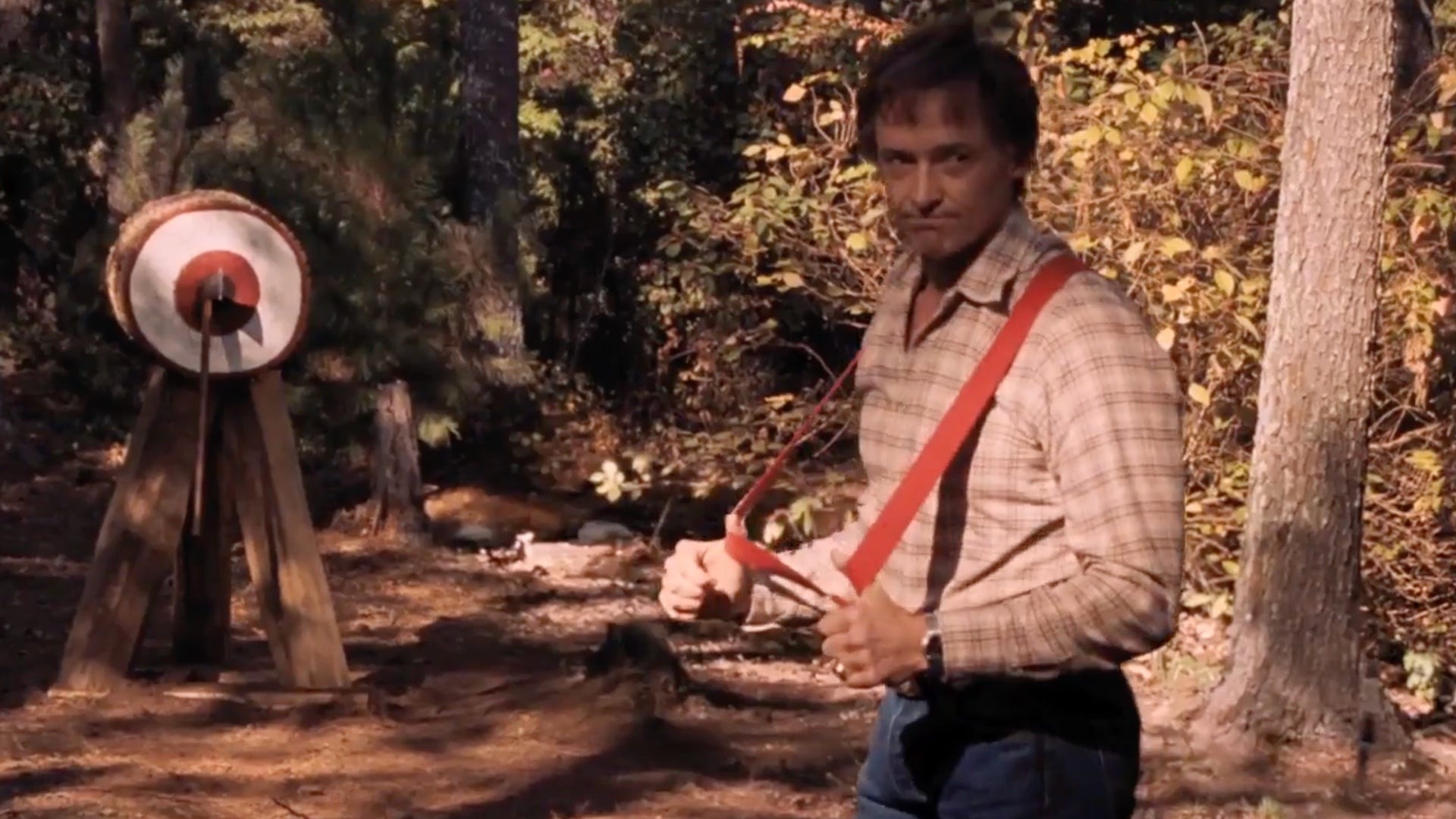
We’re at the end of Failed Oscar Bait week, and I’m glad I could cross these movies off my list as being some of the titles for which I had a borderline-obligatory interest. Borderline Obligatory Interest could really describe the career of Jason Reitman, a second-generation filmmaker who entered the industry as a middlebrow “firebrand” without a specific style, a political interest of any kind, or any real point of view. I don’t really have kindness in me for Reitman, but at the end of the day, I will be fair to him. In 2018, he had two films in the Oscar race, and neither are awful.
“The Front Runner” is one of those quaint political stories that came out during the Trump years, about a political controversy that scandalized the country when we had the moral dimension to be scandalized. The focus is on Gary Hart (Hugh Jackman), who ran for President in 1987. He’s a Democrat who, at the film’s start, is trying to find a new way to reach out to voters to remind them he’s more than statistics and policies. His campaign manager (J.K. Simmons) holds out hope, but you can sense he feels like he’s dealing with a dead fish of a candidate. Indeed, Hart is good looking, with a great head of hair, vaguely Kennedy-adjacent. His campaign likes him, which seems like a positive step forward.
His aides arrange for him to be followed by two reporters, Parker (Mamoudou Athie) from the Post and Fielder (Steve Zissis) from the Miami Herald. And for a brief moment, the two are flummoxed with this milquetoast everyman with that gorgeous Jackman face. But soon Jackman does what he, somehow, also does in “Bad Education”, the excellent HBO film that followed years later. He tempts fate, and tells the unenthused Parker to put a tail on him, in case he might find something interesting. Keep investigating. Hart lies when he puts a rhetorical button on the suggestion, preparing Parker for disappointment. Parker, like any good journalist, calls his bluff.
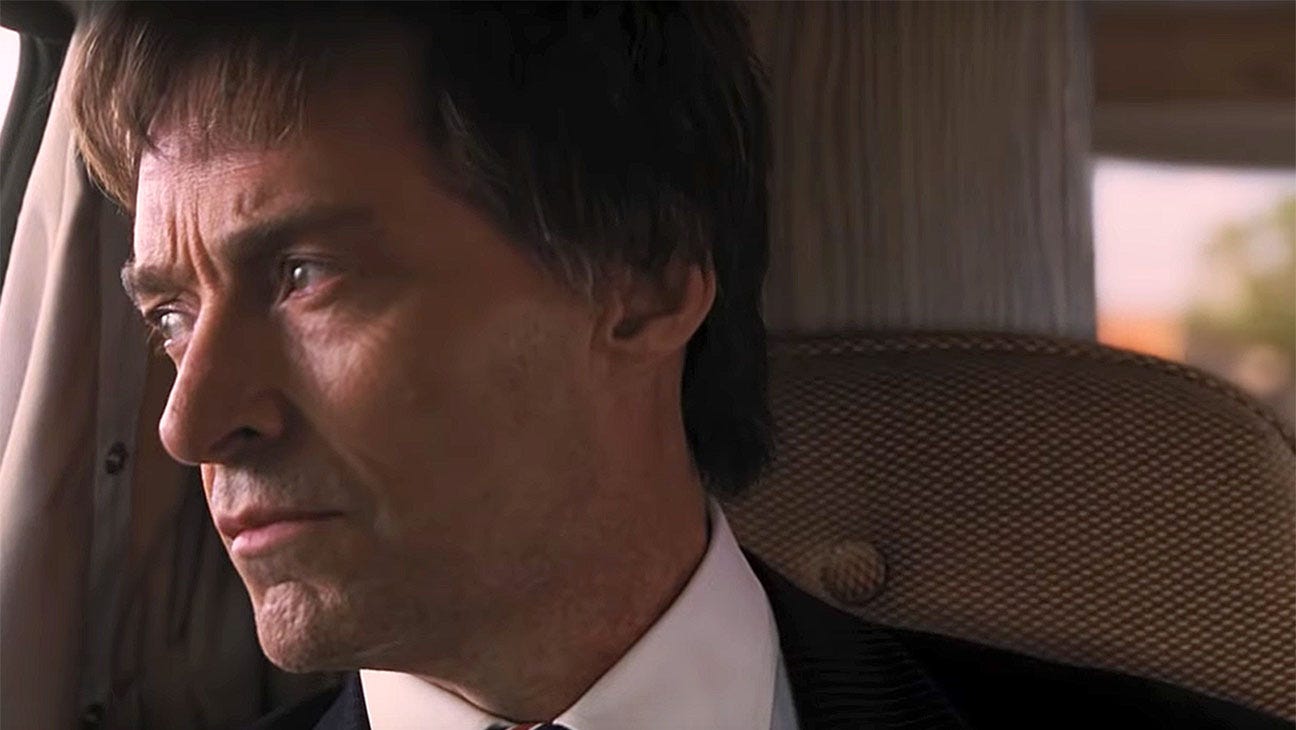
And why wouldn’t Hart be so high off his own supply? He’s a white man in Reagan’s America, healthy and pleasing to the eye. He’s got wealth, people love him, and he has a beautiful wife at home (Vera Farmiga). There’s a what’s-the-worst-that-can-happen air to the Hart campaign, represented by that bluff. It explodes when the reporters confront Hart outside his home after following a tip that lands them in front of Donna (Sara Paxton), Hart’s mistress. The novelty of this movie is that this sort of thing hasn’t typically happened before. This was a time when journalists bought into the paradox: politicians are saintly and have orderly relationships, and also sometimes a Kennedy will have a Marilyn Monroe exiting his home at unusual hours. The media used to look the other way. Now, here’s a couple of journalists literally on a politician’s home turf, seeing explicit evidence, questioning his integrity.
The reporters, conflicted, now must decide whether to run with the story or to bury it – a more complicated moral issue considering they are both from different publications. There’s also the matter of the relationships they’ve been forming with Hart on the campaign trail. He’s been friendly, accommodating, and generous with his time – is there an obligation to turn the other way when faced with an unsavory revelation? In other words, did they actually think they were becoming friends with Hart? This is a movie, so it forces you to confront the question, if you had to betray superstar Hugh Jackman in order to benefit your career, would you do it? When he has that Kennedy hair?
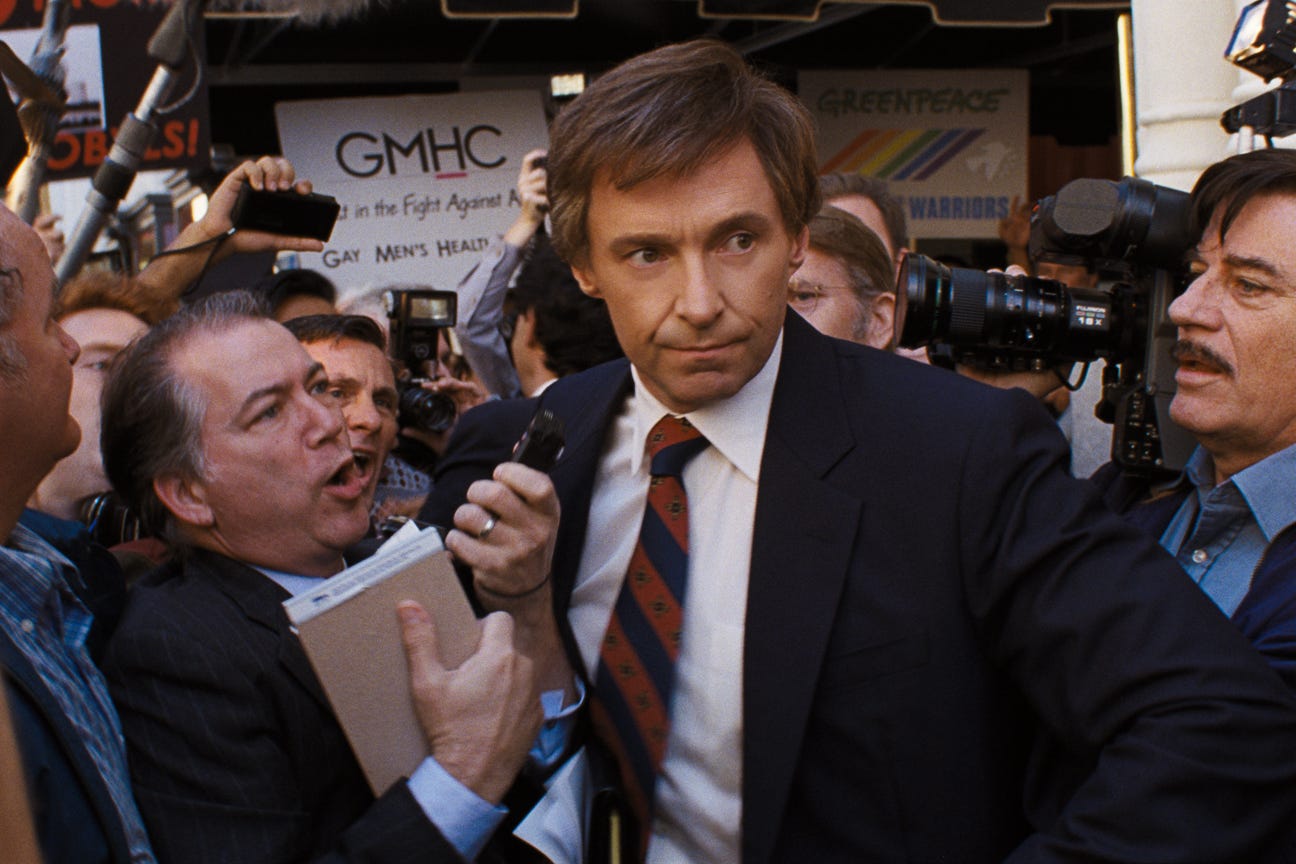
The pitch the film makes is that this was the first time in the tabloid era where political coverage was “challenged”. It wasn’t enough to have a photogenic candidate, you needed to have a telegenic one, a guy who looked good in motion and reflected no real flaws. The problem with a telegenic image is that, in the eighties and especially now, anyone can control said image. So of course Hart considers the possibility that the public might appreciate honest, they might find it appealing to hear a man confess his sins. His campaign, comparatively, thinks they need to escape a sinking ship. What happens, in other words, when the contract is broken, when the media decides to not turn the other way just to preserve a relationship?
Maybe it is or isn’t Reitman’s fault, but why release this movie in the Trump era? Why make a film where the dramatic tension came from a politician’s career being ruined because he was unfaithful when we had a President who (yes, back then) was well-known to be a rapist, sex abuser and con-man? Don’t be a child, take the politics out of it – people either voted for Trump either because, or in spite of, the fact that he was a moral vacuum, and the only other reasoning was that they were a paint-sniffing quarter-wit. The idea of making this film comes from a shift primarily in the media about how they should cover political figures, and how they are now much tougher – this after a President who never once had his feet sincerely held to the fire for his tax discrepancies, his unequivocal illegal sharing of confidential campaign documents with the Russian government, or his various infidelities, never mind his then-ongoing friendship with a notorious sex trafficker. It’s a tone-deaf movie in this context, willingly or otherwise.
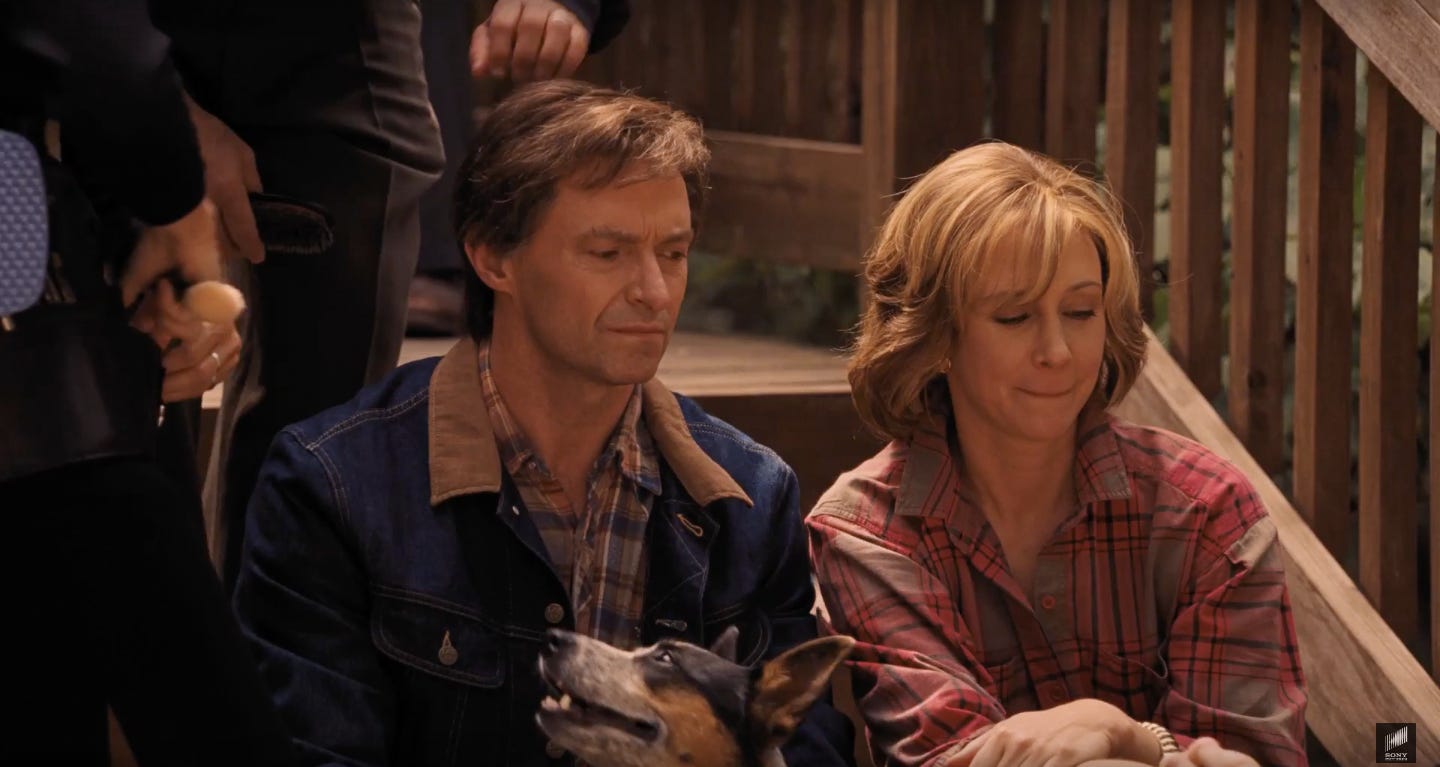
One wishes the movie could escape this hole in some manner. Jackman, especially, is predictably excellent as a man under a mask, trying to hide who he really is. But the movie stays outside of him, leaving Jackman to do the heavy lifting. Why is Gary Hart cheating on his wife? Does he love Donna? Does he loathe his wife? Is he addicted to power? Does he dislike and distrust women? Hart is depicted as a bright man, so there should be some effort to parse exactly why he is gambling this recklessly. Ultimately, his stepping out on his wife is a way to hang his whole staff to dry. How does he feel about this gamble? Reitman never gets close enough to Hart to give you any insight. Ultimately, Hart is a cipher to those journalists because they couldn’t trust what he says. He happens to be a cipher to us because we never know what he says.
Reitman’s “Tully” was also a 2018 release, hitting theaters in May following a successful festival run. The pedigree was stronger for this project, with Reitman reuniting with screenwriter Diablo Cody. Cody and Reitman first collaborated on “Juno”, which won Cody a Best Original Screenplay Oscar. I greatly preferred their following collaboration, “Young Adult”, which let Charlize Theron run rampant across a bunch of solid character actors playing suburban bumpkins. It was meanspirited and simplistic, but scaborously funny, and to see the actress finally embrace a three-dimensional comedic role was a treat. With “Tully”, it’s impossible to ignore the diminished returns of this collaboration.
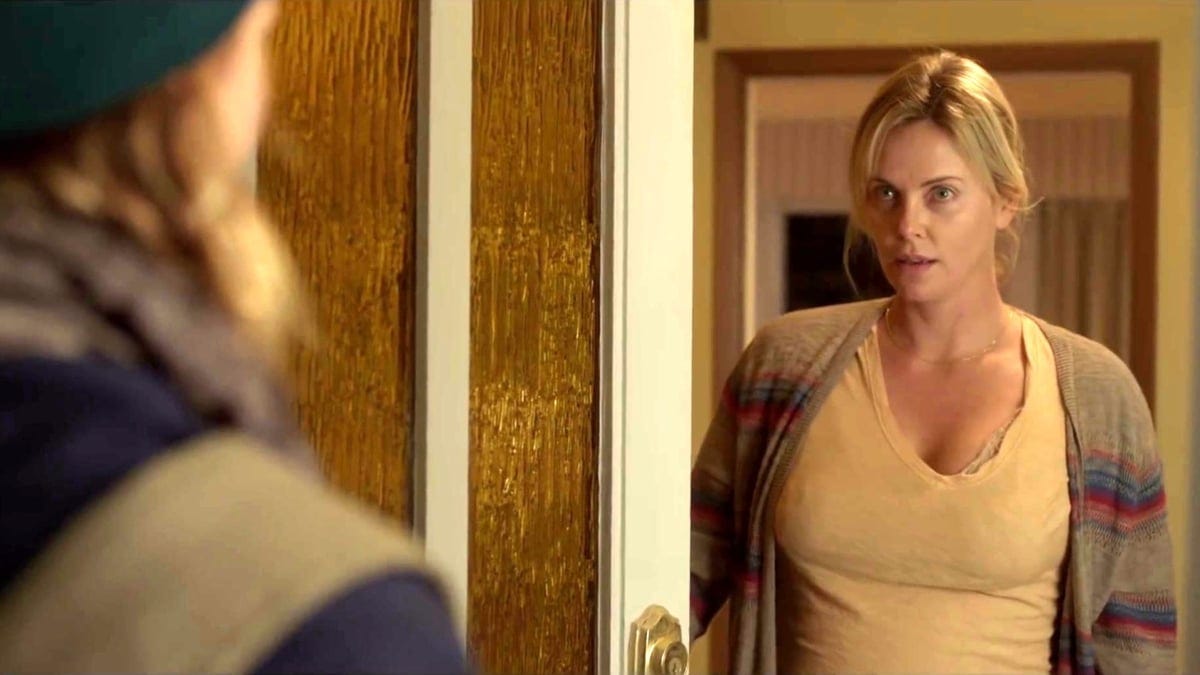
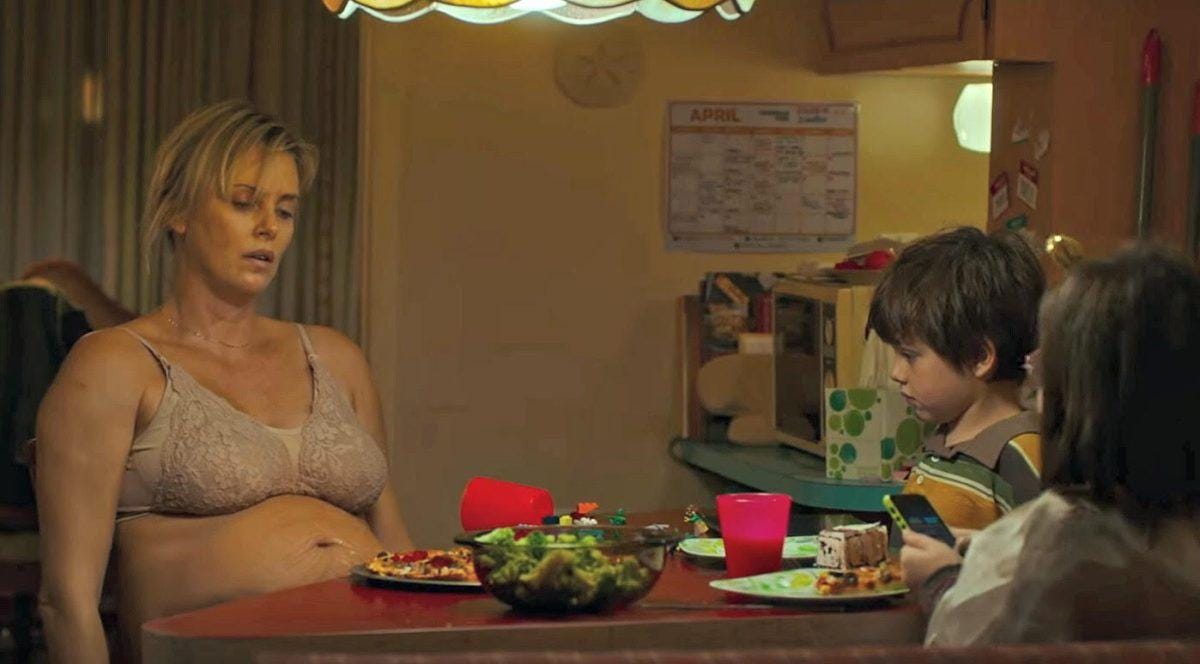
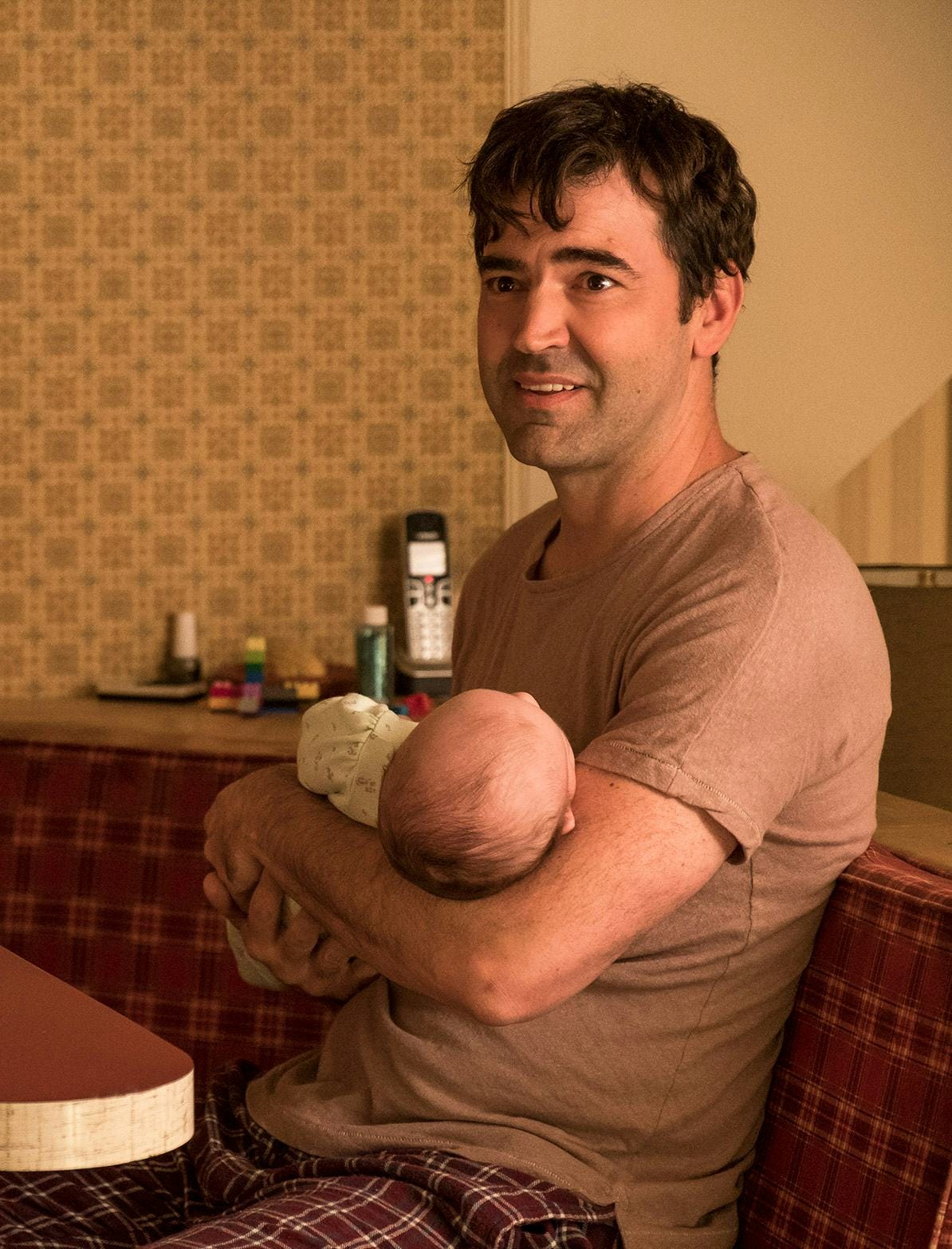
Marlo (Theron) has settled into a regular rhythm as a stay-at-home mother to two kids, with another child stirring in the womb. Like many suburban families, she’s a shell of herself, dragging her excess weight around as she cleans up after the kids and plans their whole lifestyle. When chipper husband Drew (Ron Livingston) returns from work, eager for hugs and kisses, Marlo stares at him, dead in the eyes, food dangling from her hair. Marlo doesn’t dislike this life, doesn’t hate her husband or deplore her kids. She lacks the energy to have any opinion.
As is similarly the case in “If I Had Legs I’d Kick You”, which this film shares a superficial kinship, time isn’t a fixed concept for Marlo. Mornings, evenings and afternoons are meaningless distinctions. She spends her free time watching a reality show called “Gigolos” where greasy shirtless men seduce older female customers. Full disclosure – I thought the footage we see of “Gigolos” was made specifically for the movie, absent of grace or a larger meaning. I don’t regularly watch reality television, so of course I didn’t think such a gross and cornily-theatrical show could exist. “Gigolos”, in fact, ran for five seasons on Showtime. Marlo watches the show, lying on her back, defeated by life. She is asking, “Is this what other people are like?” She doesn’t remember anymore.

Salvation arrives, and it’s young, attractive, bubbly Tully (Mackenzie Davis). She’s the new nanny, and while Marlo does not remember hiring her, she figures it has to have happened at some point. Tully immediately bonds with Marlo – she accepts Marlo’s surrender and every day exhaustion, but also her frequent dark thoughts. She is the best friend someone like Marlo can have. Marlo’s luxury isn’t that she can now live large, enjoy herself, rediscover her passion for motherhood. Her celebration lies in being able to lie down and pass out, and sometimes wake up for a quick episode of “Gigolos”.
“Tully” becomes a story of female friendship during a trying period, but it’s not a spoiler to say that there’s something else afoot. Marlo seems like a new person to her husband – rather than being suspicious or excited, he’s intrigued by this new woman who suddenly bakes instead of ordering a pizza, and who indulges in his occasional sexual fantasy. Tully is a problem-solver, someone who makes Marlo feel less like a suburban mother and more like a sexy Hollywood star in a fat suit who is doing acting exercises in a low budget movie. But Marlo has bigger problems that Tully maybe can’t solve. And even with the freedoms afforded her from her nanny-turned-friend, the walls close in.

Reitman takes a more ethereal approach than usual here, using handheld cameras on a lower-than-usual budget to reflect a tighter, more-focused viewpoint. “Tully” maintains a smaller cast list so that most of our time is spent seeing the world through Marlo’s eyes, to the point where we know very little about her husband or children, and his scene transitions, opaque and often unrecognizable, skew the timeframe. But these are less storytelling decisions and more gimmicks that run out around the movie’s halfway point. When everyone realizes We Need To Have A Talk About Tilly, the movie feels as if it’s sobering up, suddenly becoming “respectable”. A problem, considering this skinny 95-minute movie builds towards a surprise development that is introduced and then neatly resolved with little suspense. It’s the indie movie version of tying all plot strands together with a big hug. This is Reitman, for the first time, running his hand over the hot stove. And then backing away, shutting the stove off, and making sure any fire hazards have been secured.
As mentioned a couple of days ago, director Peter Berg had two “prestige” movies released in 2016 that failed to gain Oscar attention. In 2018, Reitman endured the same distinction – between these two movies, the only major award attention was given to Theron, nominatd for Best Actress at the Golden Globes. Fortunately for him, he called his father Ivan up. Ivan Reitman, the director of “Ghostbusters”, hired his son to resurrect the franchise with “Ghostbusters: Afterlife”. The results were unimpressive, though it did bother me how Jason Reitman and his production team seemed to go out of their way to distinguish their movie from 2016’s “Ghostbusters: Answer The Call”, the all-female re-imagining of the property, as if to imply there was less integrity to a female-led variation. “Answer The Call”, for the record, grossed $229 million worldwide. “Afterlife” collected a global total of $204 million. The director later returned to drama with “Saturday Night”, another festival favorite that could only muster a Best Actor nomination at the Golden Globes.
In prison, one of the more interesting rules I discovered early on was that masks were prohibited. We could not at any point cover our faces when observed by a c.o. Partly this was to show if we had any recognizable injuries brought upon by an altercation, because bruises and cuts would mean we’d immediately be taken to medical, and likely the SHU. As a result, many men kept face cream handy so that if they needed to obscure any marks, they could simply pretend they were moisturizing. But everyone had to be identified and accounted for. It’s imperative for the officers to be able to recognize and identify any inmate in custody, should they be inclined to attempt an escape. An inmate must be identified as an inmate.
What’s interesting about what’s happening on American streets is that men and women are armed and dangerous, claiming allegiance to the American government, but otherwise difficult to identify. ICE agents do not wear ICE gear, there is no ICE uniform, so they are walking the streets threatening and kidnapping people without obvious identification. It’s unclear how many people are recognizing these officers as belonging to ICE unless it is being announced loudly. And I can say, “I’m an ICE officer,” and you can say, “We work with ICE” and this next guy can say, “ICE is back with a brand new addition!” and there may be no way you can confirm or disprove this. We’ve created a situation where anyone can be law enforcement, and the government is somehow surprised that being unable to identify themselves just might cause problems for them – nevermind widespread cultural distrust.
And of course, ICE often wears masks. You’d think they would fulfill the minimal requirements made for us in prison – requirements that looked foolish during COVID, but I digress – but no, they are hiding their faces and saying they’re enforcing immigration law. This already blurs the line between armed officials with the government and armed criminals, and that’s before you take into account that ICE indeed has shot people dead in the streets. What we have here is a legal double standard. Which would make a sort of sense if we were talking about officials who follow the law, but ICE has been taking people off the street, beating them, sometimes killing them, sending them to institutions where they can’t consult their lawyers and have no medical access. The line between criminal and law enforcement agent has never been so thin. But could this approach, eagerly celebrated by the current administration, backfire? Probably never, right?
Next week we’re celebrating International Women’s Month with two weeks of DANGEROUS LADIES!
Great read! Sounds like you have five seasons of your new favorite show to catch up on.
😂 best description of Jason Reitman ever!