
Another Round
And Who You Are After Prison


I want to emphasize the complexity in cultural differences here in regards to Thomas Vinterberg’s “Another Round”. This film has an original Danish title called “Druk”, which means “Binge Drinking.” These are different principles, inherently. Binge drinking implies substance abuse and compulsion, a problem much like drunk driving – something that can be achieved, but is more likely than not going to result in danger. It carries a stigma, and rightfully so. But “Another Round” implies a choice, a choice that is not implicit in the phrase “binge drinking”. It implies that drinking is a group activity, as opposed to the solitude implied by “binge drinking”. It proposes community, and suggests celebration. “Binge Drinking” is the title the movie uses back home in the Netherlands. “Another Round” is the one for America.
This cultural reframing makes sense, as “Another Round” likely plays differently based on one’s cultural identity and relationship to booze. Vinterberg intentionally forces you to wrestle with that idea, as his films tend to operate within layers of moral ambiguity. Here, he’s reteaming with Mads Mikkelsen, and previously the two of them collaborated on “The Hunt”, about a schoolteacher accused of sexual assault. That film left the truth about the accusation unknown – at least allowing the question as to what extent an interaction would have happened. Mikkelsen, thick and masculine and not unhandsome, is not exactly the type you’d imagine to take advantage of his young students. But when you see his aggression and frustration and pent-up anger, it opens the window just a bit more.
In “Another Round”, Mikkelsen is one of four teachers, good friends who all teach, in various manners, at a school in Copenhagen. Mikkelsen’s Martin, the ostensible leader of the pack, seems like he’s having the least fun. When he asks his wife if he’s boring, her answer is, “Compared to what?” Probably the worst way that can go! At the 40th birthday party for one of the guys, they all propose an idea – booze, but with microdosing. They see the enjoyment the school’s oldest students get out of alcohol, drowning in intoxication on the weekends, no concerns or worries for the future. There may be generational jealousy afoot. Regardless, the plan catches hold – just a bit of drinking each day, none at night, no driving, no foolishness. A small peck, and their brains will be rewired, their middle age suddenly given a kick in the head.
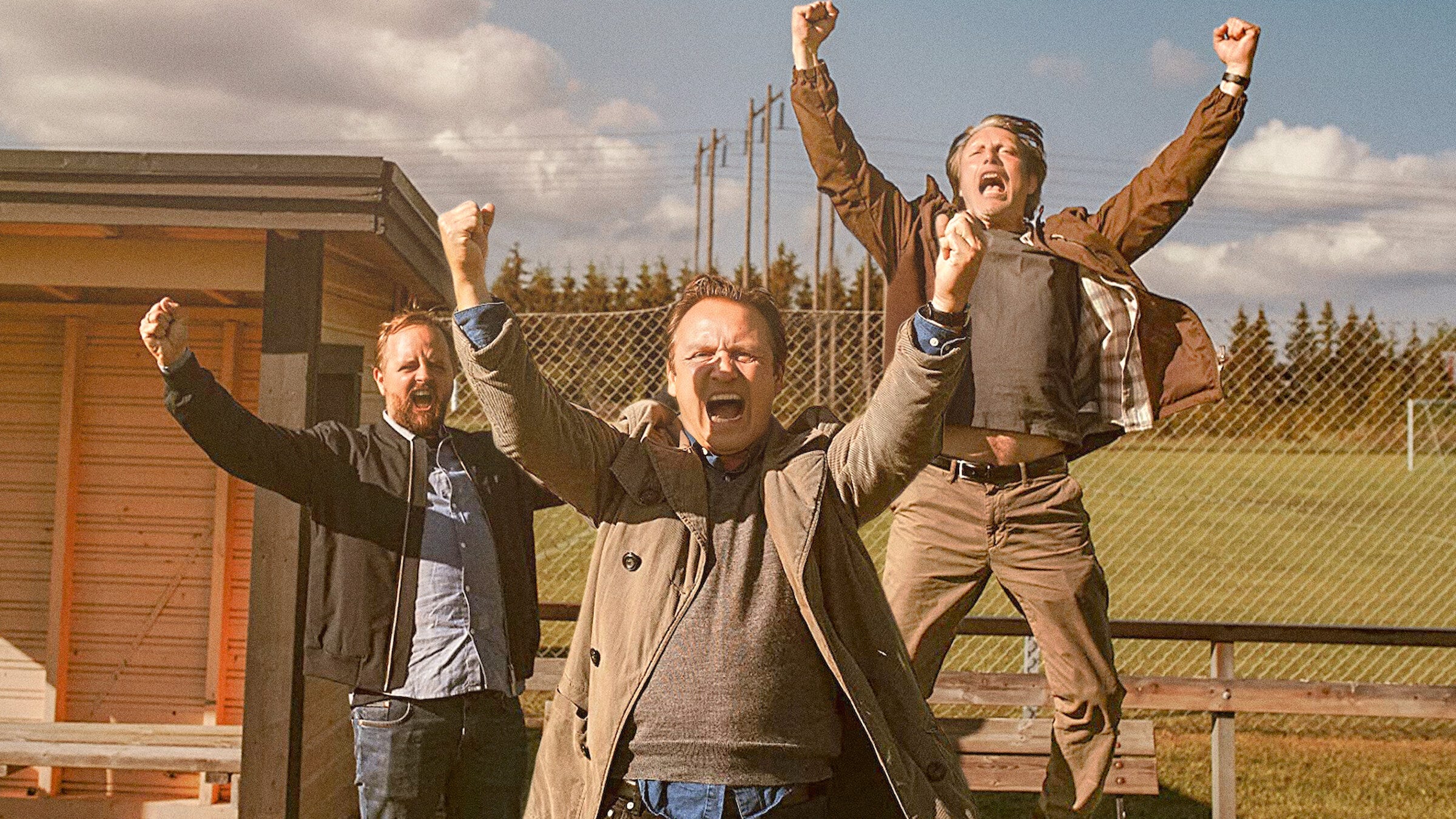
And very briefly, it works! Suddenly, they come alive to their spouses and their students. Life has a little bit of extra energy, and a whole world of possibility. These best friends now get together like little boys alive at the renewed vigor for their daily lifestyle, keeping the blood alcohol content at 0.05%. And then it becomes 0.10%, and the audience starts to have fun too. I genuinely think, while the male gaze is focused on reducing women to sexual object, the female gaze (while also often interested in men as items of titillation) is a bit more expansive, and includes the rare idea of men getting along in homosocial environments as well. So there is obvious appeal (also among men who relate to this) to these men having a good time amongst each other, turning back the clock to kick around a soccer ball and embrace what feels like newfound freedom. It’s genuine male camaraderie, removed from any actual toxicity.
But, uh, yeah… sorry to be the bearer of bad news, but we’re still talking about alcoholism. These guys get ahead of their skis, and there are consequences. What felt like a thoughtful comedy of manners becomes tragic. As they look askance at the older students, still wrapped up in their weekend drunken revelries, they confront the idea that the past is over. “Another Round” is, as such, an elegy, a lament. More spirited and vibrant than the usual films from Vinterberg (a filmmaker with a long history of challenging films), it’s not a surprise that it cracked into the Oscar field with a nomination for Best Director and a win for Best International Feature Film. It probably won the latter not because it’s foreign or exotic, but because it’s relatable. Every man of that age, of which I am now, has tried to find a quick fix for that slippage. Few of us ever truly want to accept it.

I aged enough in prison that it can be argued that I have a bit of dysmorphia. I went in after I had turned thirty, and I got out at 39, losing, essentially, my entire thirties. So by the time I turned 40, I honestly did not know what I was meant to feel. I didn’t know what it meant to be forty, or to feel forty. Even now, I’m not sure what my age represents, and if any aches and pains I have are natural for my age, or a product of heavy living. Prison preserves people, as long as you live semi-responsibly. I came out of prison looking just as youthful, at 39, as I did when I was in my late twenties. In some ways, despite some salt and pepper in my facial hair, I’ve maintained this appearance. It’s as if I’ve time-traveled.
At the close of “Another Round”, there is a now-iconic moment of soft-shoe on the part of Mikkelsen. The actor, like the character, was a former dancer, which spurs on these unbridled moments of joy. I don’t know if I can harken back to my youth similarly. I don’t remember most of it. Prison was a vessel through which I passed, and I’m not recognizable from the person I was except for perhaps my face and some parts of my body. I can’t “go back” to who I was, what I was, since I lost everything, and what I didn’t lose simply was phased out of existence. Aging means little to me now. I suppose this will change as my body is ravaged with age and the limitations that come with it — I’m sure that’s coming soon. But it’s almost like a simulative experience – who am I now, and how did I become this person through great tragedy and devastation? I know people my age wonder how they got to where they are, and the answer is, basically, “age.” I wonder what I’m supposed to say.
Next week, it’s five days of PRISON MOVIES!
Interesting to hear what men go through around aging. With women it's becoming invisible and no longer the subject of the male gaze as either a romantic or employment possibility. Quite a shock when women are used to being gazed at.
Time and gravity are the silent and stealthy ravagers no matter who you are. So it's surprising that you didn't age as much in prison.
I actually really enjoyed that movie. I remember my mom called me and asked if I’d watch it with her, lol. I was like …. Mom! But I am so happy I did.
I know what it’s like to lose time. I hear you. ✨✨🥹