
The Tender Bar
And How Much More Expensive Prison Is Getting

Argh, George Clooney, they just let you direct now, don’t they? There’s no more demand, it’s just something that happens and everyone nods their head. I used to look forward to a new Clooney movie as an actor or director, as he seemed reasonably discerning as far as subject matter. That was several years and several movies ago. I was happy when he could justify semi-retirement by making hundreds of millions from a new tequila, because it meant that he could be choosier than ever. And then, during this year’s Super Bowl, he was shilling for GrubHub. When did you give up, George?
I followed his acting choices during my bid. Sections of “Tomorrowland” absolutely delighted me, I loved the retro-futuristic aesthetic, even if it crumbles under the clunky third act storytelling. But Clooney gives a sour, one-dimensional turn as the Skeptical Adult In A Children’s Film, and it was impossible to ignore that the movie’s most inspired segment – the opening ten-to-twenty minutes — don’t involve him at all. From there, it was a saggy re-teaming with Julia Roberts in “Money Monster”, the type of movie people from both sides of the aisle hate – the right knowing it’s just lefties preaching to the choir, the left bemoaning bloodless, apolitical plot contrivances that went stale in 1993. The 90’s seems relevant to Clooney, because for a while it felt as if he was reflecting the sudden generic experimentation idol Robert Redford embraced during that decade, where he complicated (and maybe sullied) his Sundance Kid reputation by starring in crap like “Indecent Proposal” and putting his name on forgettable mirthless slop like “A River Runs Through It” and “Havana”. I know, shots fired.
Clooney appeared in the ensemble for “Hail Caesar!”, which was plenty fun, even if it’s lesser Coen Brothers, and that’s before they committed the unpardonable sin of cutting Dolph Lundgren from the finished picture. Apparently Clooney thought that collaboration would rub off on him, because then he decided to adapt a long-buried Coen script, resulting in the inert “Suburbicon”. Though that one has an amusing Matt Damon performance (... why does Clooney only work with the same five dudes?), it proved Clooney’s comic gifts behind the camera had essentially evaporated. He took another break, shot a completely unremarkable Netflix movie, and that lands us at “The Tender Bar”.
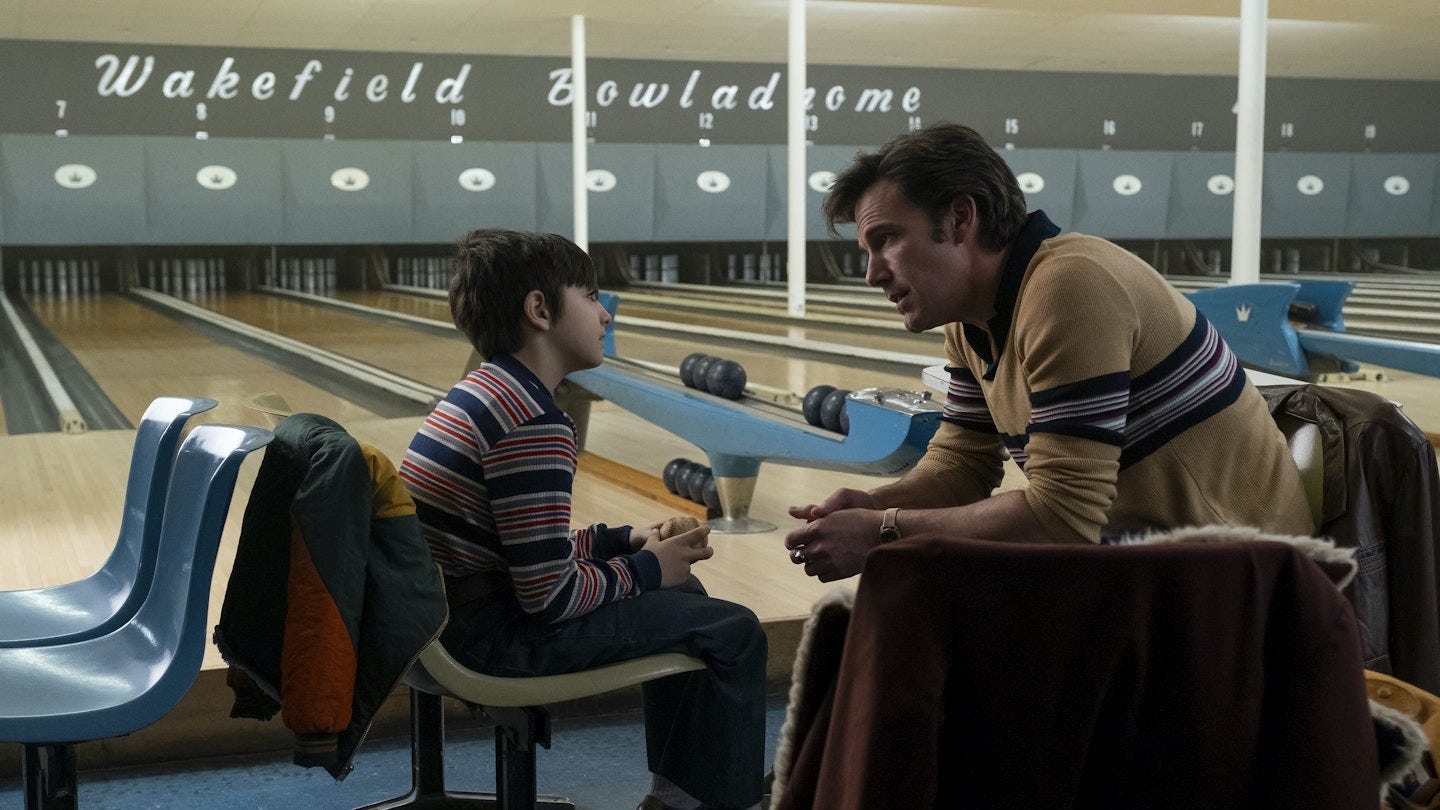
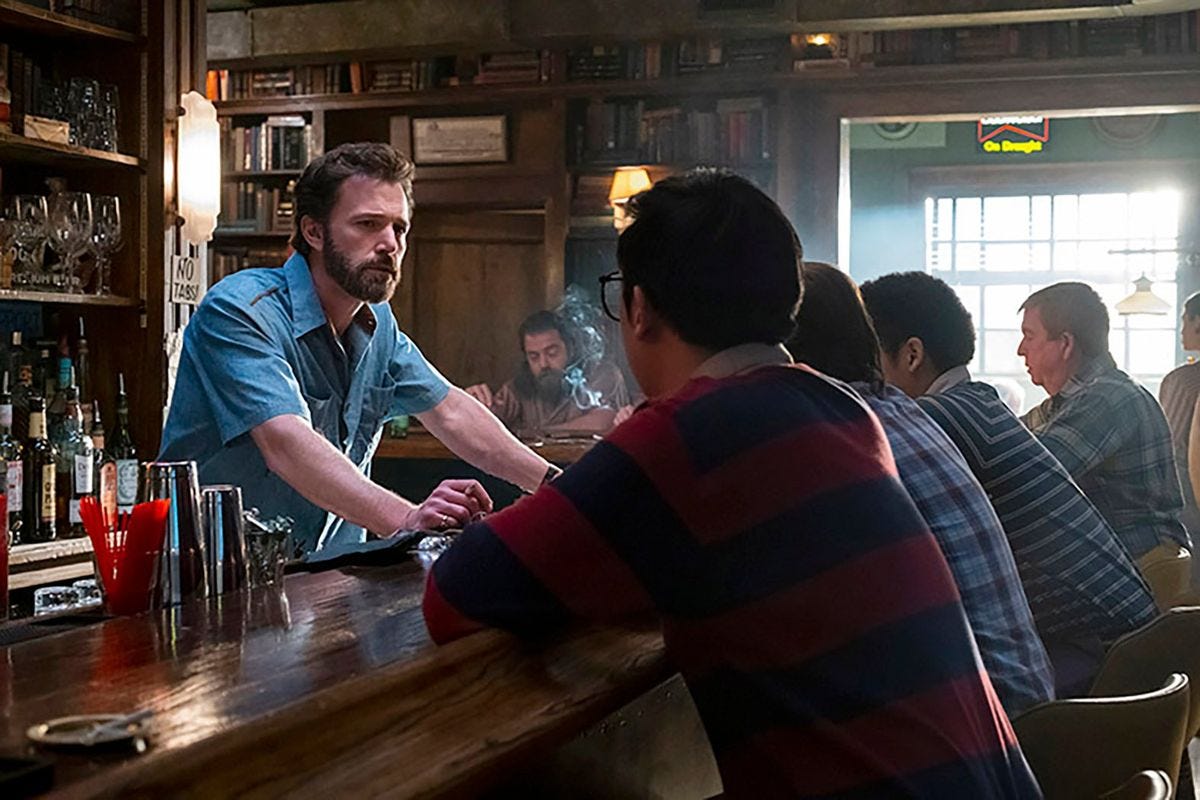
Why did I blather on like that? Because it’s a lot of activity, and a lot of failure, that lands a tired Clooney in “The Tender Bar”. This is the kind of movie that studios would make in the nineties, a safe space for a director in between two significantly bigger projects, with predictable and easy story rhythms. Those seeking challenges, do not enter. It’s based on a memoir by journalist J.R. Moehringer (a spoiler, I guess), who had a working class Long Island upbringing in the 70’s, in the wake of a father who, paradoxically, was ever-present and never there. He didn’t ever come home, drinking and carousing all over the neighborhood. But he was also heard on the radio, a daily DJ heard by an enthusiastic young “J.R. Maguire”.
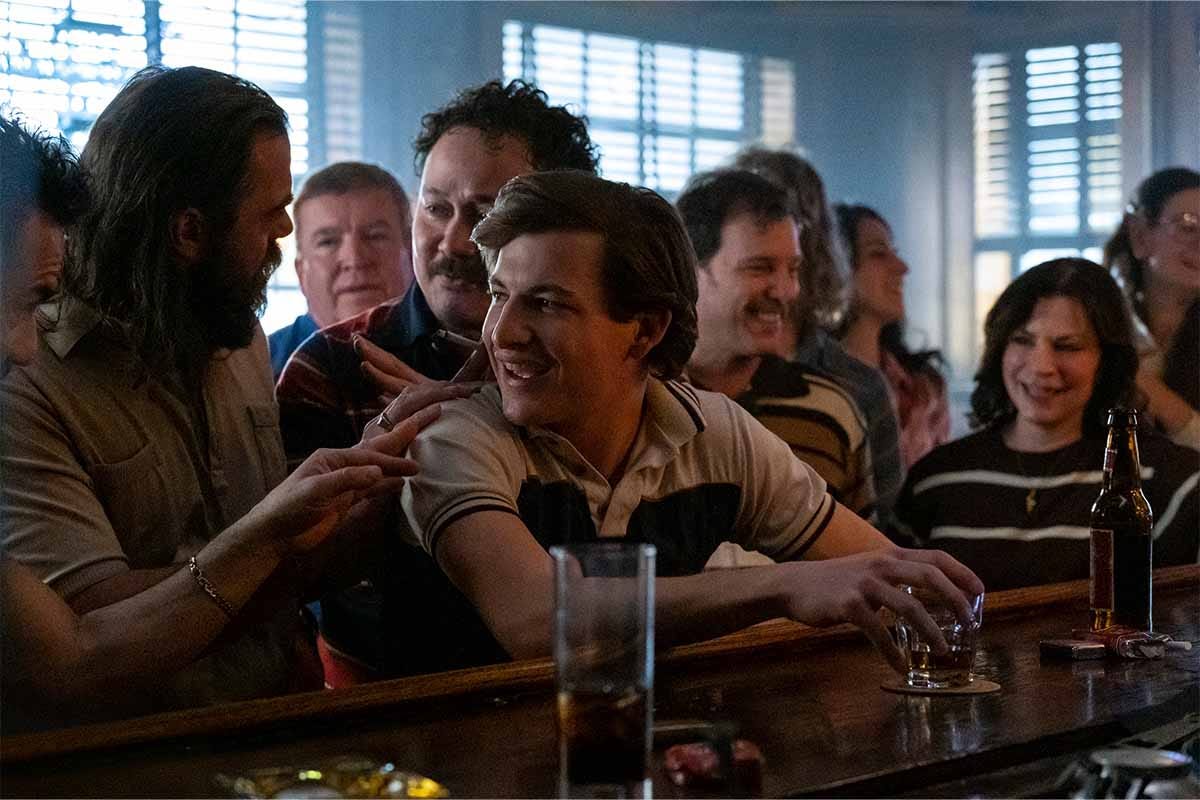
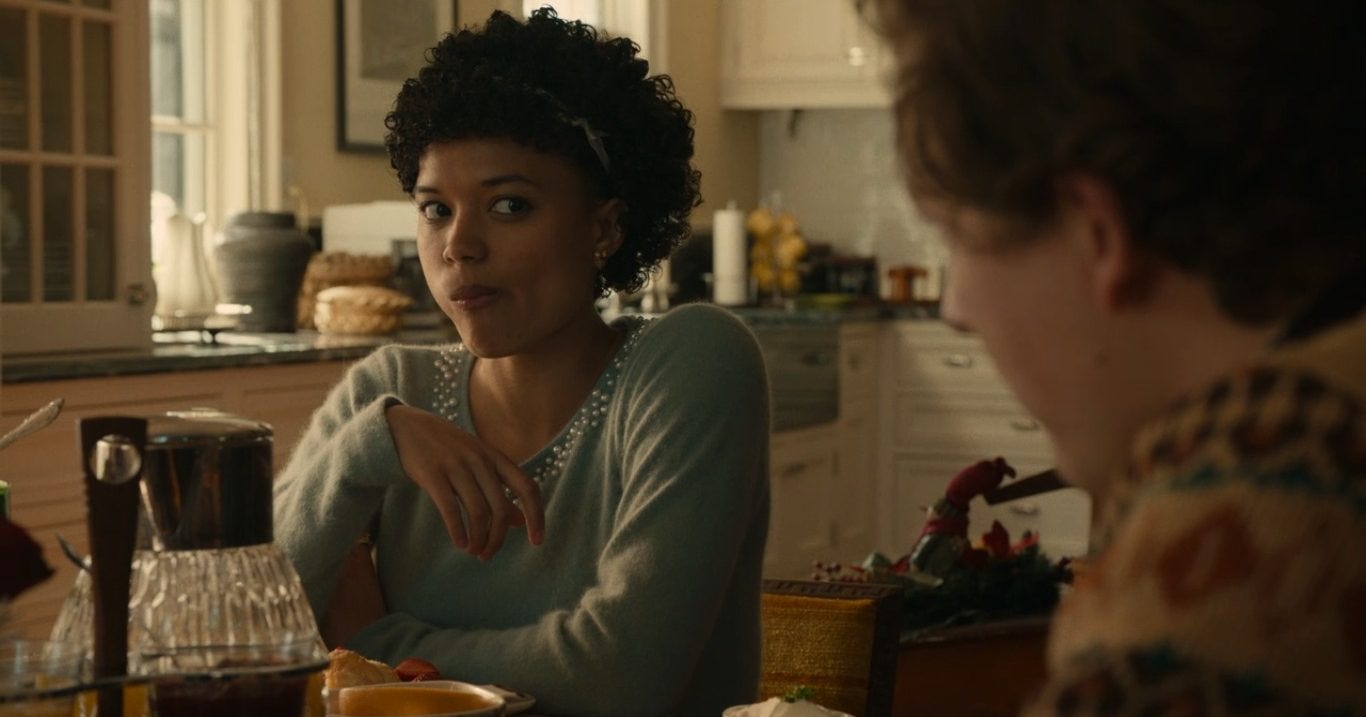
Absent a father figure, J.R. finds guidance from his protective uncle Charlie. The supportive, good-natured Charlie takes J.R. under his wing and teaches him the finer points of manhood, but he also lets him be himself. When J.R. shows an aptitude for the written word, Charlie early on challenges him to see if the young boy is really committed to writing. As he becomes a teenager, he grows into Tye Sheridan, a young leading man who just missed stardom, largely due to basic movies like this where he doesn’t have much to play. Indeed, much appears easy to young J.R., particularly his seduction of Sidney (Briana Middleton). There’s a moment when he’s confronted by her wealthier parents, who give him guff about his working class roots. Almost immediately, he returns the lip. It’s a subversion of what we usually see in these scenes – the boyfriend biting his lip until it’s too late – but it doesn’t supplant the missing drama with a corresponding compelling tension.
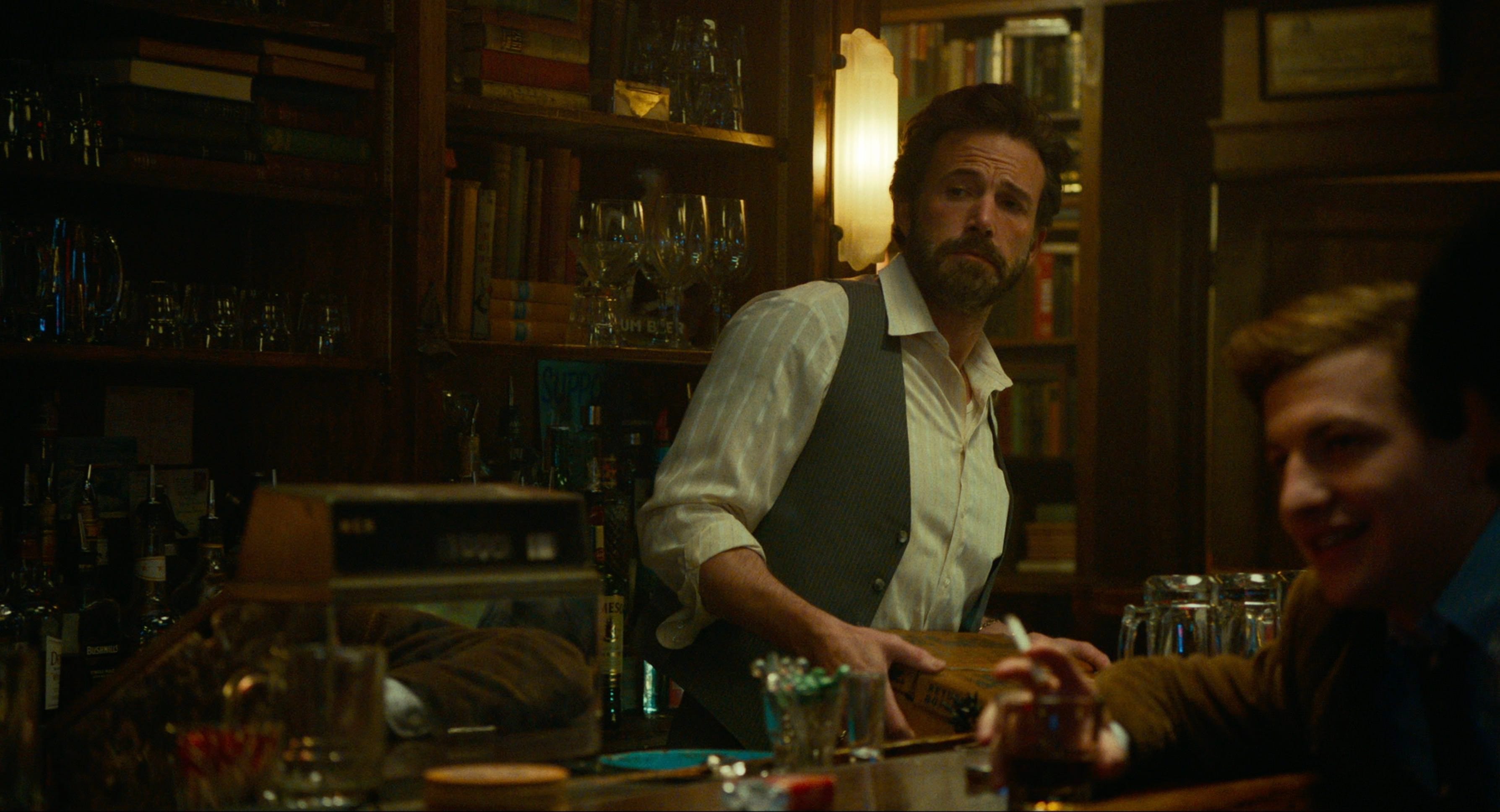
If Clooney shot “The Tender Bar” a decade earlier, he would have saved the part of Uncle Charlie for himself. Instead, it falls to the always-busy Ben Affleck – he shot this after the end of the pandemic (and shortly following reshoots for “Zack Snyder’s Justice League”) but this was his thirteenth film from 2014’s “Gone Girl” until 2021, if we’re counting “Justice League” twice. He’s come a long way since “Voyage Of The Mimi” – his Charlie is a calming presence on the movie, a charming rapscallion who has to bat back concern from his sister, J.R.’s mother (Lily Rabe). There’s always a little bit of hambone to Affleck, and he’s not the most versatile actor (in fact, put this performance side-by-side with his comic bartender turn in “Extract” and you’ll see similar mannerisms). But he gets the best lines and the movie sags when he’s offscreen – even when J.R. is coping with his paternal issues, you wish Uncle Charlie could walk onto the scene and sort it out. Because this movie is so thin, it’s also nice to see Affleck, the tabloid fixture, stuck in the Batsuit at the time, in a movie where he can look so clean and fit and healthy. That was not often the case during this particular period for him.
“The Tender Bar” feels so defiantly like a three-star movie that you’d have to call it a two-star movie, just because its mediocrity is so consistent over the course of the runtime. Which kind of reveals the uselessness of the star system, really. At around the tenth time someone tells J.R. he can write and Everything Will Be Okay – each time warm and convincing enough – you kind of resent how dedicated the movie is to its tired three act biopic structure. It’s a modest movie, a shy movie – that’s not an accident, but more than a few times you wonder why this particular story needed to be told. Aside from a few colorful supporting turns – as J.R.’s friend, Rhenzy Feliz of “The Penguin” is a scene-stealer, and Christopher Lloyd is always a welcome presence – it’s appropriate this landed on Amazon, content to play when no one is paying attention. At that point, maybe it just becomes a one-star movie? This is why I don’t do “stars”.
There’s a world where “The Tender Bar” quietly opens in April and plays steadily until the beginning of July, where most viewers would think it’s a lighter John Grisham joint. But Amazon ambitiously launched it in December, complete with an awards campaign. Predictably, the one person who received any attention was Affleck, who earned a Golden Globe nomination for Best Supporting Actor – he lost to Kodi Smit-McPhee for “The Power Of The Dog”. Despite also nabbing a SAG Award nomination, Affleck did not land any Oscar attention in his category, in the year Troy Kotsur won for “CODA”. Affleck, for the record, has no Oscar nominations as an actor. Given that he’s won two Oscars, for writing “Good Will Hunting” and for producing “Argo”, I’m certain he’s doing fine.
Prison remains a business, I don’t need to remind you of this. But what’s notable is how that business evolves – or doesn’t. The prison population has declined in America, mostly due to reforms, and yet the costs rise, costs that support a broken system, propped up not only by taxpayers but, notably, by the families and friends of those who are incarcerated. Naturally, the industry continues to find ways to charge everyone more, nakedly profiting off suffering. It’s worth taking a look at this report, which very neatly lays out exactly how much money, in the billions, prisons are making in order to support a system where more than half of those who are housed are frequent offenders.
What struck me is the $27.7 billion spent every year by those on the outside. They have a brother who was shipping product, or a father who collected child pornography, or an uncle who was involved in a credit card scam, but they themselves did not break any law. And yet, that’s money for their commissary. Commissary money, which will be used on toiletries and necessities, on food and snacks, on stamps and paper, on phone calls typically at $3.15 per fifteen minutes, as well as money converted into digits to allow emails and the purchase of music. That also includes bail and fines. It doesn’t include the money spent on gas to see their incarcerated loved one, the money spent on finding appropriate clothing for the visiting room (any woman has to remove underwire from their bras, for starters). It doesn’t involve the money spent feeding their incarcerated love in that same visiting room, where they have to decide between a number of overpriced vending machine foods and drinks. It doesn’t include the money spent to remind an inmate that they’re more than a number. It’s misery, calculated. Prison officials eat with this money, conscience-free.
I somehow have never heard of this movie. I was waiting for the reveal that it was actually some AI spoof or something they made for 30 Rock, but no, real movie that disappeared into the COVID ether. Great write up