
Enemy
And The Prison Abolitionist Addicted To Prison

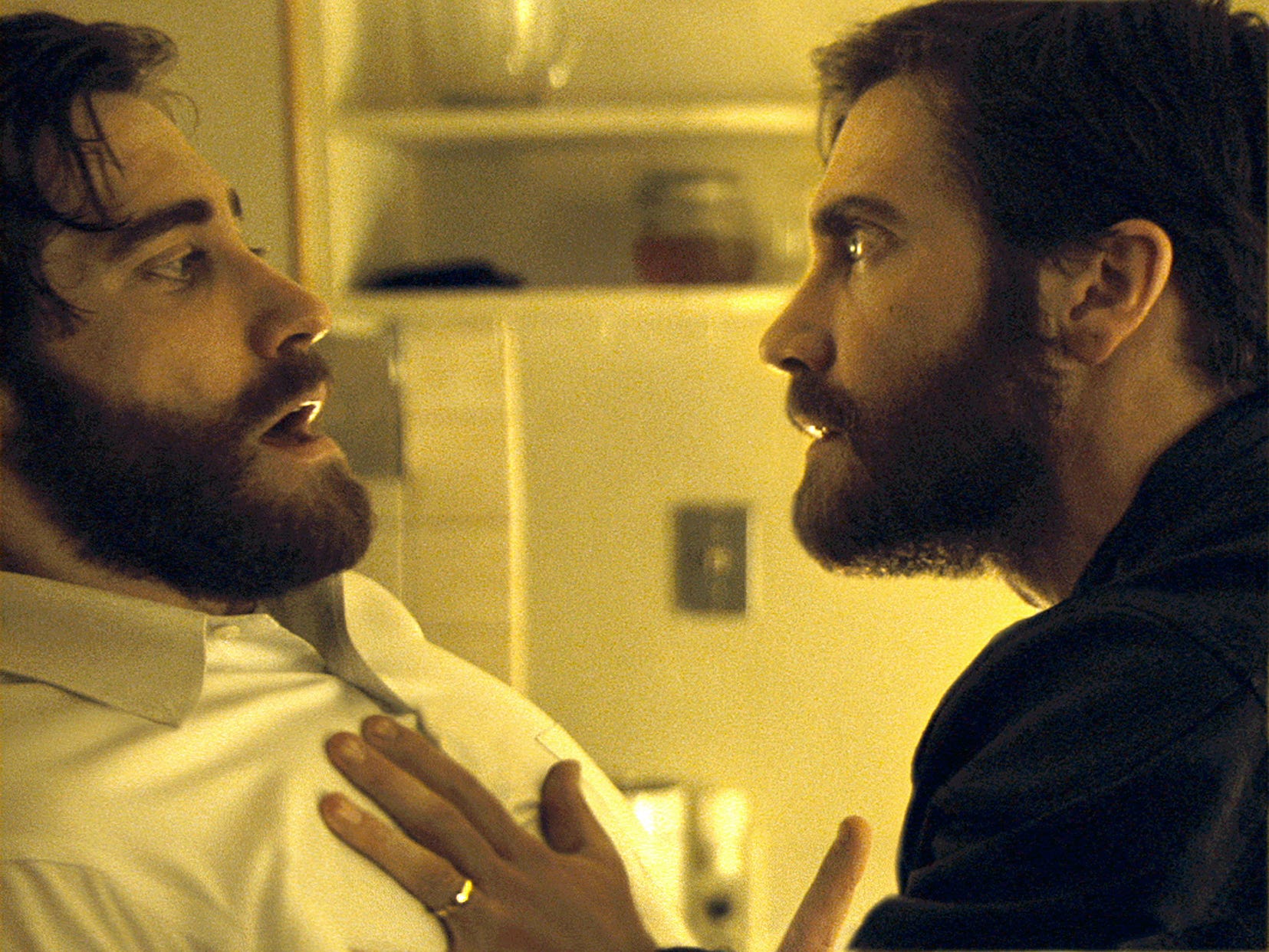
“Enemy” was winding its way through festival screenings in the period before my incarceration, though I didn’t pay much attention to it. By the time I was in prison, cracking open Jose Saramago’s “The Double”, it’s adaptation “Enemy” was far from my mind. I was delighted to find it was a rather playful, lightweight tale of a man completely taken over by the idea he may have a doppelganger. Of course, that’s how I interpreted it – books don’t typically announce their vibe so loudly as other mediums. Though I had previously consumed Saramago’s “Blindness”, which was notably more bleak and pessimistic, “The Double” is largely about that impossible-to-scratch urge to know more than you ever possibly can, to provide answers in a universe that doesn’t make sense.
Consider it a surprise to me that Denis Villeneuve’s adaptation of “The Double”, now aggressively named “Enemy”, was a dark and severe bit of nastiness, starring maybe the most intense leading man of this era. “Enemy” isn’t as explicitly conveyed as his “Prisoners”, nor does it benefit from the massive canvas Villeneuve would adopt for his later bigger-budget efforts. This is a movie openly defiant of a simple answer, focusing on a man who is determined to attach a precise meaning to a cosmic impossibility.
Jake Gyllenhaal is Adam, who lives a comfortable middle-class life in Canada. He is unfulfilled, and therefore susceptible to suggestion, like a specific movie recommendation from a coworker. This leads him to a movie, a generic programmer he watches at home that nonetheless contains an upsetting wrinkle. The bellboy in this film is a carbon copy of Adam. He can’t recall any family members who would be actors, so he immediately wonders, who is this person? After catching this man in a couple other movies, he reasons, it must be me, or someone who has become me. In the 2002 novel, there was a satisfying sequence of research and study through stacks of VHS’s. Unfortunately, this more modern version loses that analog touch.
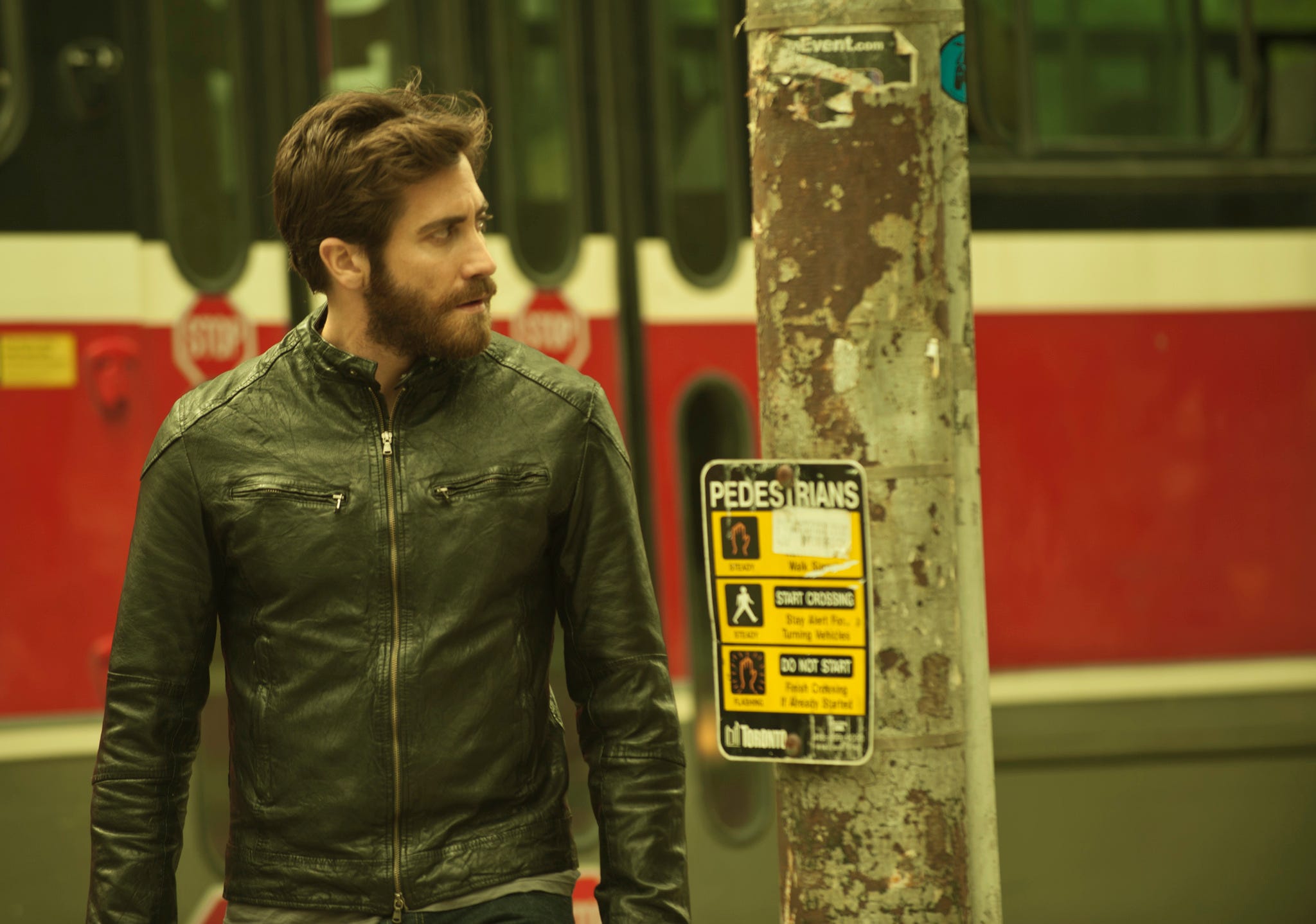
Instead of this being a cute story he can share with his girlfriend Mary (Melanie Laurent) (or maybe a goofy obsession he hides from her), Adam surrenders to the mystery, looking this man up and trying to grasp his significance. He tracks Anthony down, seeing that he’s a working actor with a pregnant wife Helen (Sarah Gadon). Oblivious to the notion that he is intruding on someone else’s life, he begins to lurk on the periphery of Anthony’s world. Wasting no time, Helen begins to track this man making suspicious phone calls to her apartment and she discovers Adam at work. But it’s the boys who become consumed. Anthony downplays the incidents to his wife, though soon Adam and Anthony are meeting in person, trying to hash out how the two of them are, improbably, exact doubles.
“Enemy” takes place in a Canada that feels cloudy and yellow, the cinematography a bleached honey color that allows for multiple shades of shadow, but only one hue of brightness. It feels as if characters are always either on their way into a darkness, or just emerging from one. The movie is bookended by a curious idea of a hidden room, where events occur that I will not describe (an addition I believe was not in the source material). The entire movie, you’re waiting for someone to return to this room, subterranean, maybe sulfurous, possibly an attempt to womb back, a vestigial retreat. The punchline for this idea, perhaps this whole movie, is a shocking visual concept, a metaphor for how one can be subsumed by an idea that once felt they could control. It’s enigmatic to the point of unsatisfying. Somehow, I think it works, though it’s an idea I’ve been wrestling with ever since.
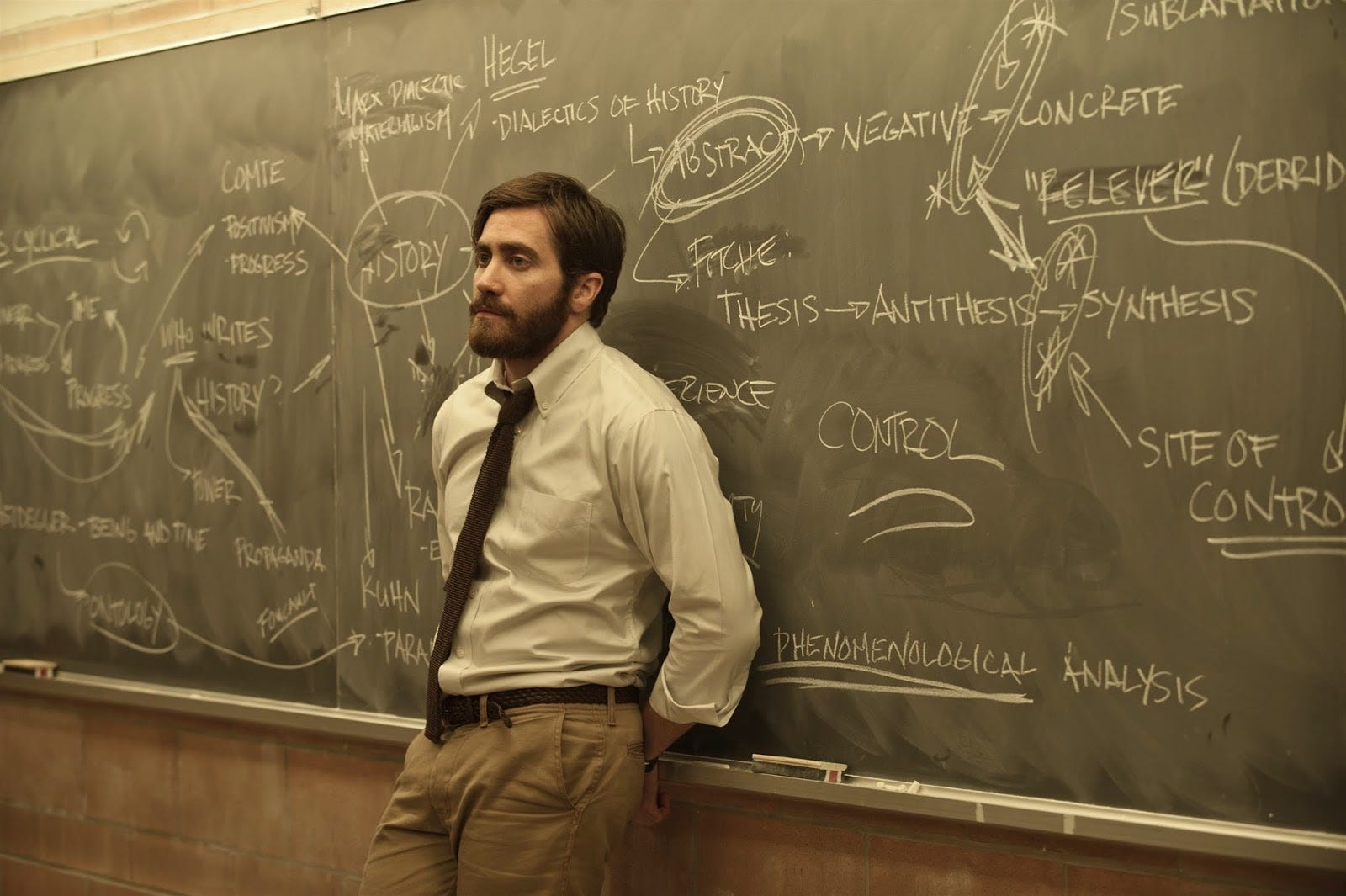
“Enemy” plays the conceit straight in a way that made me think, perhaps, there’s a comedic intention somewhere. The idea is inherently absurd, though Villeneuve grants the tale his customary intensity – his other work suggests it’s not a put-on, and yet I can’t rule the idea out that they’re all goofing on us. The film spirals into one specific psychosexual direction, absent the inner monologue of the book, and it runs the risk of being in-line with any number of sillyy tales of doubles switching places, pulling a trick on those around them. Maybe I just find Villeneuve’s maximalist intensity more than a little funny – “Prisoners” feels like a parodic version of a Lifetime thriller at points, compelling on one level and absurdly belabored on another. His ponderous “Dune” movies are similarly indebted to their form, unable to break from their forceful genre restraints. Are his movies, particularly this one, a little funny? Or am I just eager to laugh at them? Or am I laughing with them? “Enemy”’s oblique exit, the most confounding conclusion of any of his films, keeps me guessing. I like that.
I’m not sure if you need a subscription for this (DM me if you can’t read it), but I couldn’t get over this wildly fascinating New Yorker article about Alex Friedmann. Friedmann had done time in his youth, addicted to the idea of being a stick-up kid in spite of his obvious intelligence. During his time, he refined his interests, studying law and understanding the criminal justice system, enough that he merged as an activist. He wasn’t decarceral, exactly, but he believed in steps that were required to make prison a more tolerable experience for those who seek to better themselves and seize opportunities. He developed respect and a reputation for a plainspoken analysis of the system from a legal perspective, not that of an ex-con. His story is inspiring to me, at least as long as you stop telling it at a certain point.
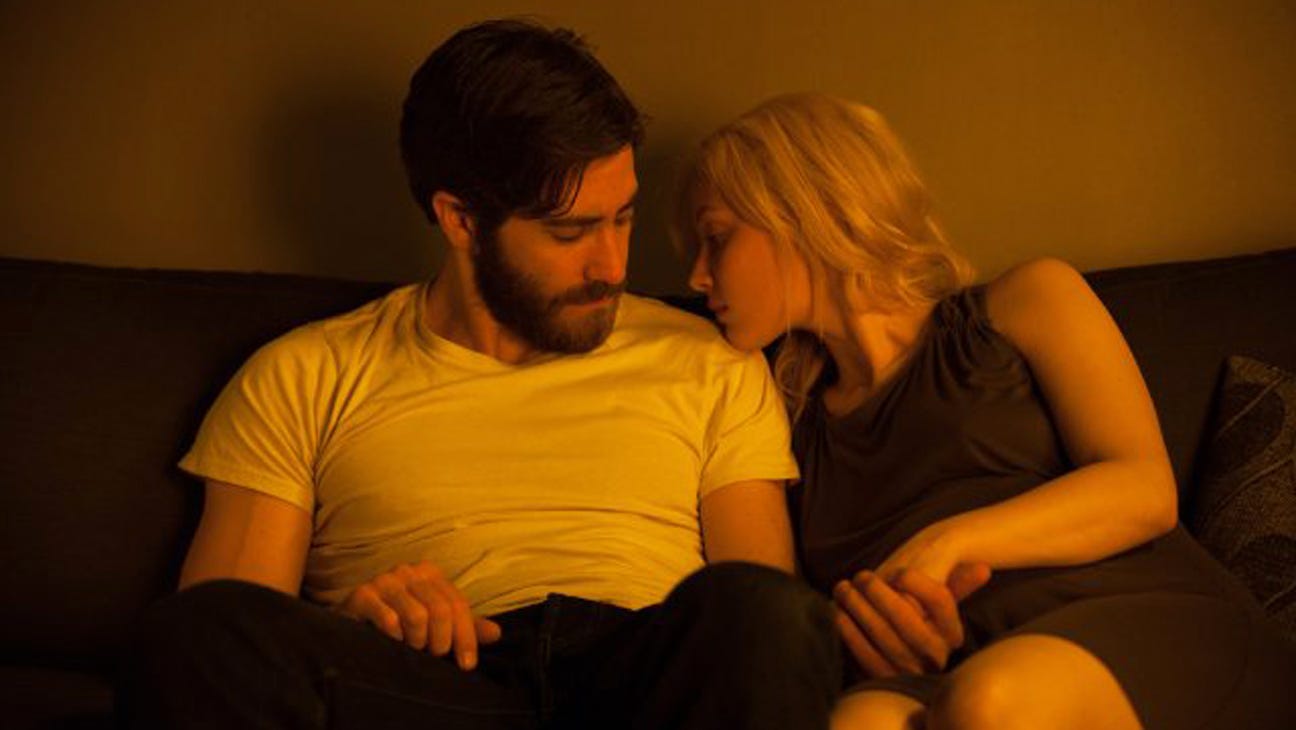
In a crime no one can accurately explain, Friedmann was caught placing a gun within the infrastructure of an institution that was in the process of being built. The belief is that, decades after his incarceration, he was haunted by the possibility he’d be arrested once again, taken into custody and forced to defend himself. He was institutionalized, in other words, forced to confront that his future would be his past, spent in custody. I am troubled by this story, as he was outspoken against the system’s inequities, but still mentally imprisoned by it. It makes me wonder about a thought I have fought against – the idea that when you are imprisoned, you are in many ways imprisoned forever. I am sitting still, out in public, typing this. But is a part of me still sitting in a bottom bunk in a prison dorm? Is my freedom an eternal delusion?
Some experiences are indelible, but we can keep them in perspective and continue to learn from them. I think that's what you are doing. They don't define us, but they change us in ways we hopefully understand better as the years pass. My experience is with addiction, so very different from yours, but most serious "experiences" are like Pandora's Box...there are all sorts of things in there!!