
Zeroville
And The Lies Told To Normalize Brutality

When I was down, I found a valuable resource from a place I can’t recall: a list of books about movies, fictional narratives based on filmmaking and cinephilia. As I made my way through that list, one of my favorites ended up beig Steve Erickson‘s “Zeroville”, which followed an antisocial loner who goes by the name Vikar as he bumbles through Hollywood during the seventies and eighties. The book boasted the delightful conceit of combining completely fictional developments with real life historical events, cheerfully combining the contrived and the real in developing a plausible story of an industry outsider in love with movies.
The movie, by contrast, was released with a whisper. This was yet another of the passion projects of James Franco, and in this case he called in favors from all of his funny friends. Because of a few questionable behind the scenes issues, the movie sat on the shelf for several years. It appears as if it only earned a release well after these same funny people long ago stopped talking to Franco in real life, due to a number of accusations of sexual impropriety. Which is of interest because this is a tale, with its hazy sense of chronology, that only ends up feeling outdated, yet another celluloid celebration of a time (or times) we’ve rightfully abandoned.
Franco directed and stars as Vikar, who comes to Hollywood as if he was just born on the bus to Los Angeles. Vikar has all the signs of autism – in the book, though I’m not sure Franco ever properly conveys this through his performance– and he garners attention with a boldly-shaved head, most of the real estate taken up by a tattoo of Montgomery Clift and Elizabeth Taylor in “A Place In The Sun”. In the book, this tattoo almost feels like a living creature that has crawled out of his brain. You can almost hear the little monster hissing at those who don’t recognize the allusion. Unfortunately, because this movie is visually and conceptually flat – and because you sense some overzealous editor trimmed this footage down to the neighborhood of ninety minutes – onscreen, it only comes across as a tattoo.

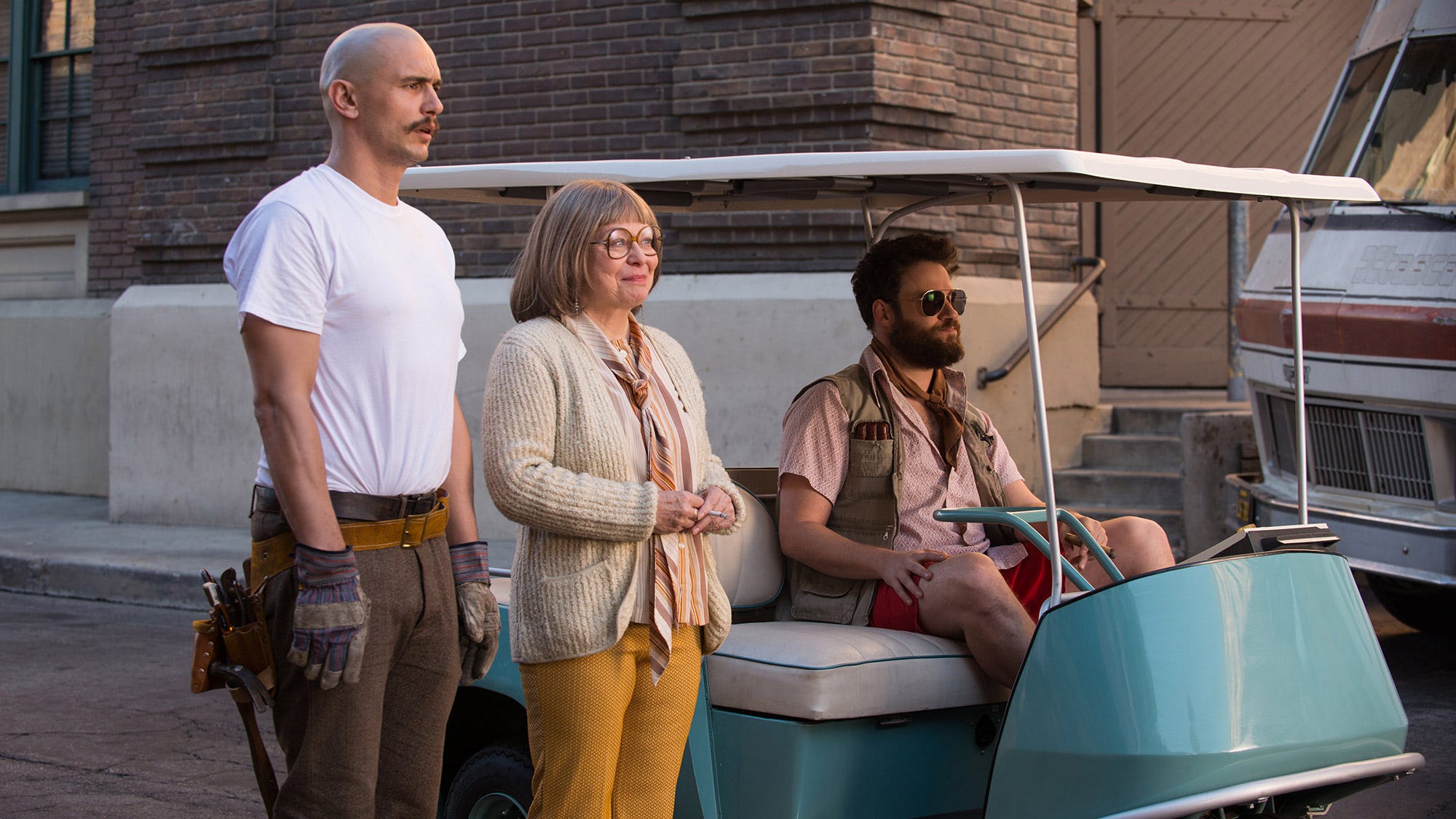
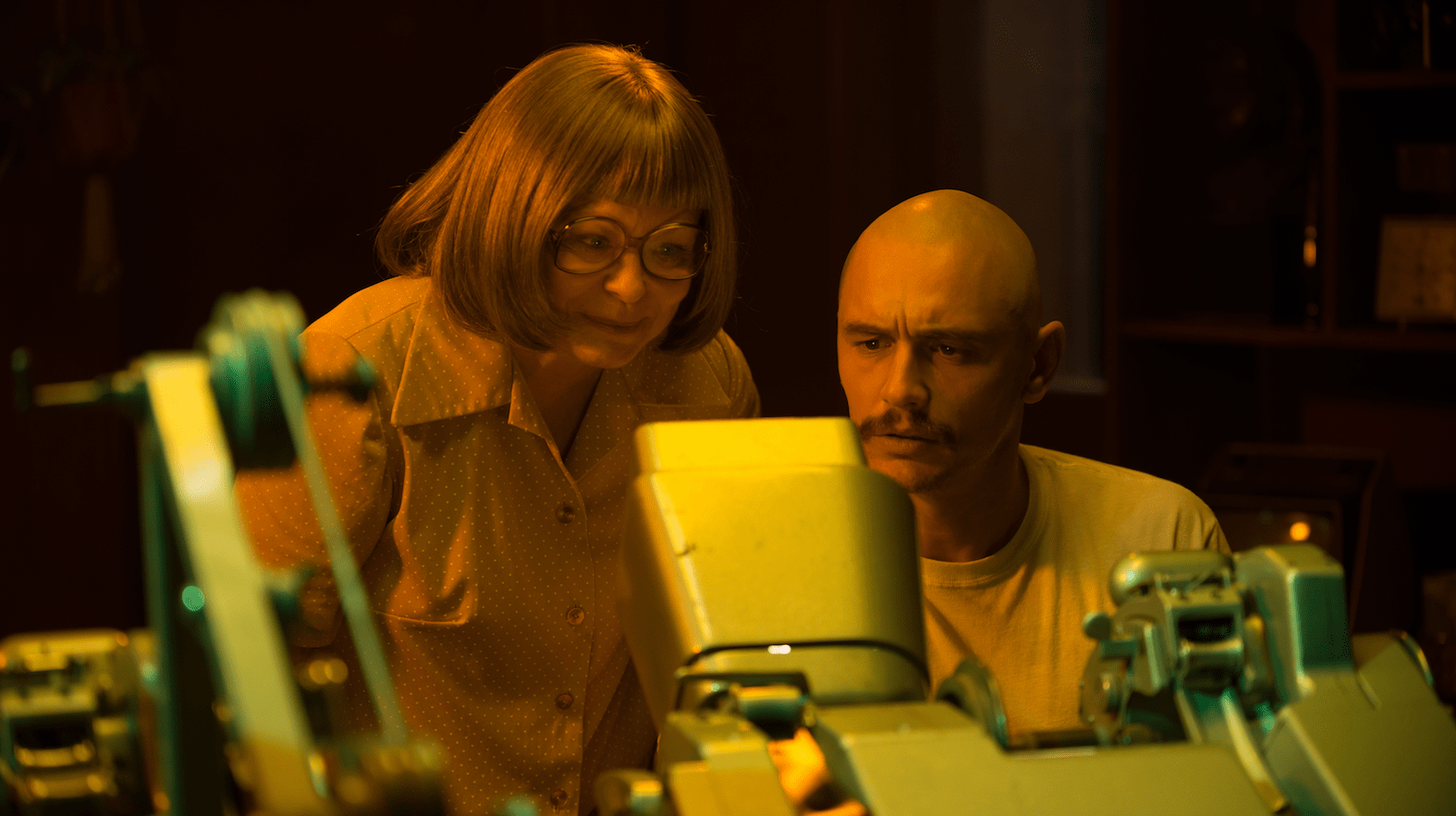
Vikar wanders onto a studio lot and ends up working on the sets, inarticulate in his show business dreams. Along the way he gets harassed by cops played by Mike Starr and Danny McBride, and he trades rapport with a cinephile thief unconvincingly personified by Craig Robinson. You can hear the flipping of Franco’s Rolodex. He eventually falls under the tutelage of Jacki Weaver‘s sweet-natured editor, a character whose gentle kindness serves as a contrast to the film’s overbearing cynicism.
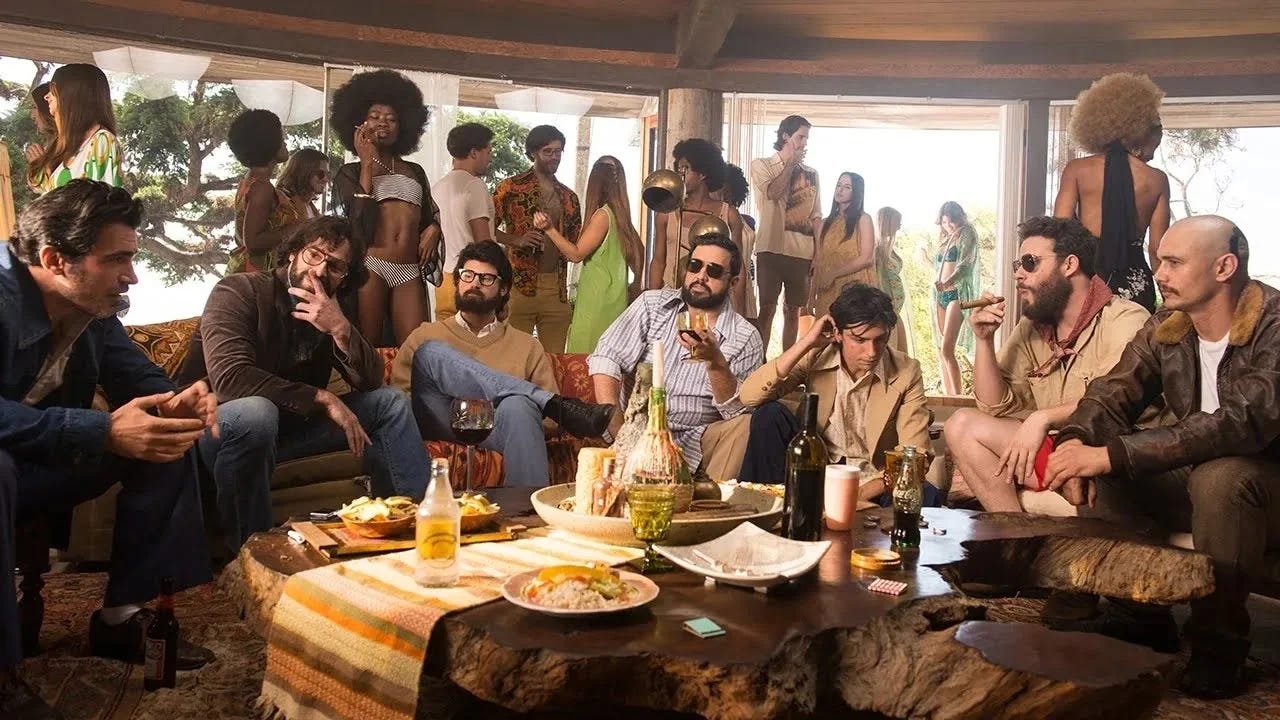
An olive branch into the filmmaking world is extended by Seth Rogen as the mysterious Viking Man. I run hot and cold on Rogen, who is generally a pleasant presence in films, but who has struggled in his middle age to imbue his characters with depth. Here, he’s another boastful hot shot meant to be a seductive but negative influence on Vikar, and most of what he does is gesture with a fat cigar and curse at everyone. At one point, he shoves a gun in the face of George Lucas at a party where George suggests his buddy Steven make that big shark movie with “robot sharks”. In the book, this recreation of that era is hazy, picked up from fragments and misinterpretations. In this movie, befitting Rogen’s sloppy performance (playing largely against Franco’s silence), it’s just dumb fratty shenanigans.

Vikar finds his footing as an editor, reshaping the visual vocabulary of a few abandoned films (some real) as well as his own pictures. Mostly, he’s brought in as a pinch hitter. In manufacturing the shaky narrative of a Jess Rollin-type arthouse horror film, he falls for the movie’s star Soledad (Megan Fox, vacant). As if it wasn’t deadly enough to watch a possibly-autistic character try to flirt with Megan Fox, it also arouses the anger of the producer footing the bill. I love Will Ferrell so, so much. But this is a serious role, and he’s playing it like a skit, particularly in a sequence where, again, he has to employ his painfully dissonant singing voice he seems to break out in every other movie.
“Zeroville” the novel has an anticlimactic structure, as Vikar is a passive protagonist, and the story’s final act uses a time jump to engage in a suspenseful plot thread that emerges from the faint periphery of the story. But on film, the storytelling is shallow, erupting in fits and starts, skittering head to random moments in a non-specific chronology. Franco directed many movies, but he never showed an aptitude for style or timing or rhythm, and his work behind the camera seems to rattle around like a train on broken tracks. He has an amateur’s skill with montage, and he’s never able to hide a film’s budget, insufficient for a movie like this that has so many locations. There’s a sequence on the set of “Apocalypse Now”, and it’s the kind of opportunity that any filmmaker would dream of recreating. Here, Franco makes it look like it’s the dark backstage of a school play. Adding insult to injury, Horatio Sanz plays Francis Ford Coppola.
Was Franco ever a filmmaker, or just an experimenter? He jumps into the film’s last act, sort of a metaphysical mystery, by breaking tempo, switching from color to black and white, and creating a fractured visualization of Vikar’s mindset. Which wouldn’t be a bad approach if the earlier parts of this movie followed through on the idea that autism was a helpful trait for an artist – ill-considered, but at least a point of view. Instead, we move from Vikar the 1980’s savant spouting Wikipedia factoids, to Vikar the possessed maniac obsessed with solving an impossible mystery. The book largely follows that last plot strand, but it has no space for the curdled sentimentality of Vikar learning what it means to be a father. Sometimes, you love a novel (or a song, or a book, or just a story). And sometimes you misinterpret it as a paper-thin tale of redemption. This wasn’t the first book Franco the director tried to wrestle into a small box. Looks like it might have been the last.
I notice how the pattern of ICE detention right now parallels the early days of mass incarceration. What many don’t know is that in the 1700’s, when prisons began to spring up in London regarding the control the rich desired over the poor, they were met with dissent and disorder. Law enforcement was primarily a tool of the wealthy to stem disputes. And so the citizens fought, they took to the streets to tackle the over-extension of the police state. We only have mass incarceration today because of “moderation” – the government found a way to temper their behavior until it became “palatable”, and enough of the general populace mistakenly signed up for the illusion of orderly law enforcement under the umbrella of safety. As this current government replaces ignorant bureaucrats who break the law with competent bureaucrats who still break the law, normalizing the criminality of ICE is a slow but steady journey for those who wants us to accept criminal brutality as the norm.
One of the reasons I was worried about dying in prison is that, as someone alive within those walls, I knew I had to fight for my narrative against the institution’s word. But if I were to be incapacitated or killed, the narrative would entirely be in their hands. This is becoming a regular story in the ICE camps, about a teenage boy who died and was said to have committed suicide despite a lack of direct communication from the institution. When I broke my jaw in prison after I was jumped, I was placed in the SHU, and could not reach out to my family. And when they reached out to the institution, they heard varying contradictory stories about my condition. They felt for the sake of security that they could not share details of my condition, but then they couldn’t get stories straight. As is the truth with liars, they couldn’t get their stories straight. In the case of Royer Perez Jimenez, the boy is dead, and that has clearly given ICE a license to spin lies with no regards to the family. Abolish ICE, as we should, but this won’t stop happening in our criminal justice system.
Love this