
Wind River
And Prisons That Murder

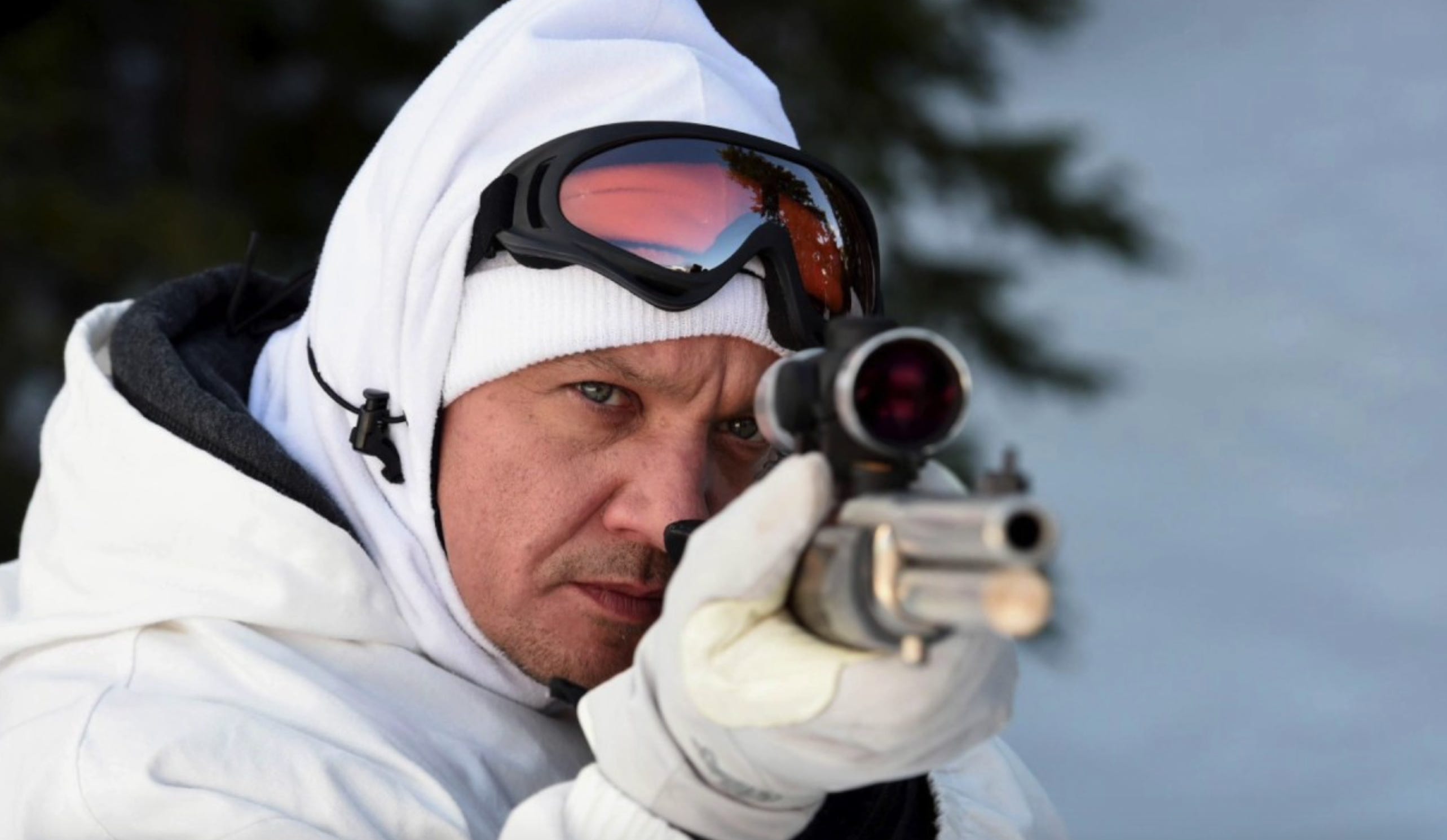
A hallmark of the Oscars are movies where minorities are showcased as oppressed people capable of grace and purity. These movies typically fit the Oscars’ purview, however, if they’re palatable to the average white Oscar voter – in other words, said oppressed people have to be seen through the eyes of ideologically-compromised white people. That gives them a character arc! You really think the Oscars are watching “Dances With Wolves” with an all-Native cast, and without a Kevin Costner in need of Healing™? They’re not. They barely watch the movies already.
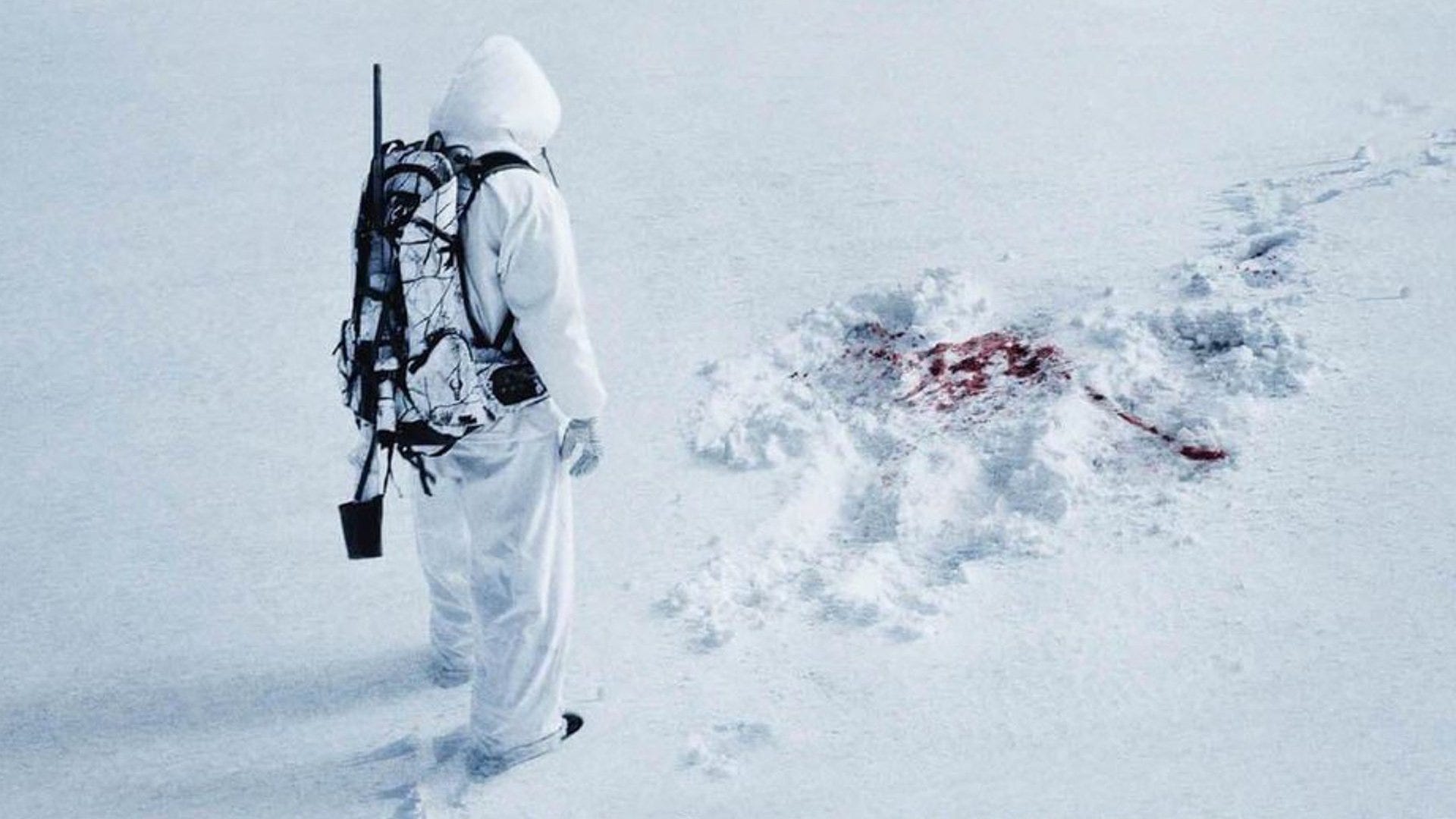
“Wind River” comes from writer-director Taylor Sheridan, from right before he conquered television. Like most prestige television, it begins with a bit of familiar dramatic currency, a dead girl – this one out on an icy Indian reservation. She’s found by Cory, who typically deals with wildlife. He’s Jeremy Renner, so he’s severe and intense but with a possible soft center. He asks questions. Eventually, the coroner cannot answer them. This is a movie about cruelty and dismissiveness regarding the violence towards indigenous and marginalized women. The dumber among us would consider this virtue signaling, except that the movie makes an excellent point – many marginalized women who are assaulted come from marginalized communities, places that are literally off the grid. The victim was sexually assaulted, but ultimately it was the conditions, the environment, that killed her. Distinctions like that only feed a culture of abuse, and emphasize the disposability of female bodies. So when people are underreporting sexual aggressors in these scenarios, nobody is blaming the patriarchy as much as they’re blaming common-sense environmental issues.
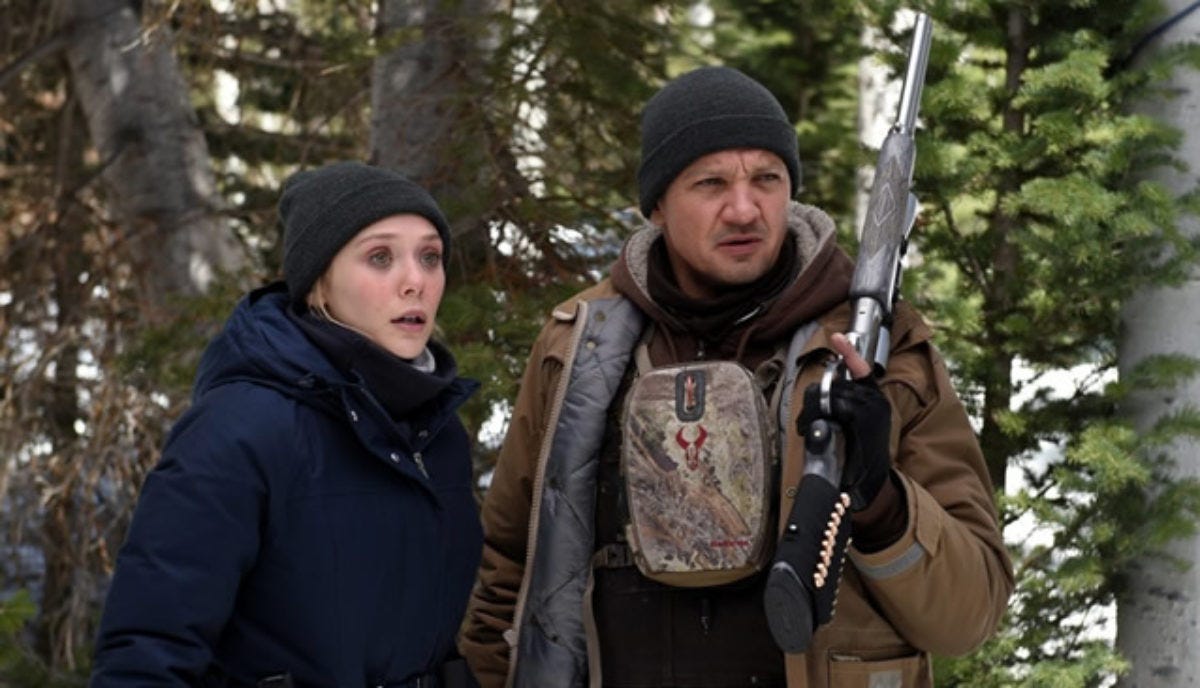
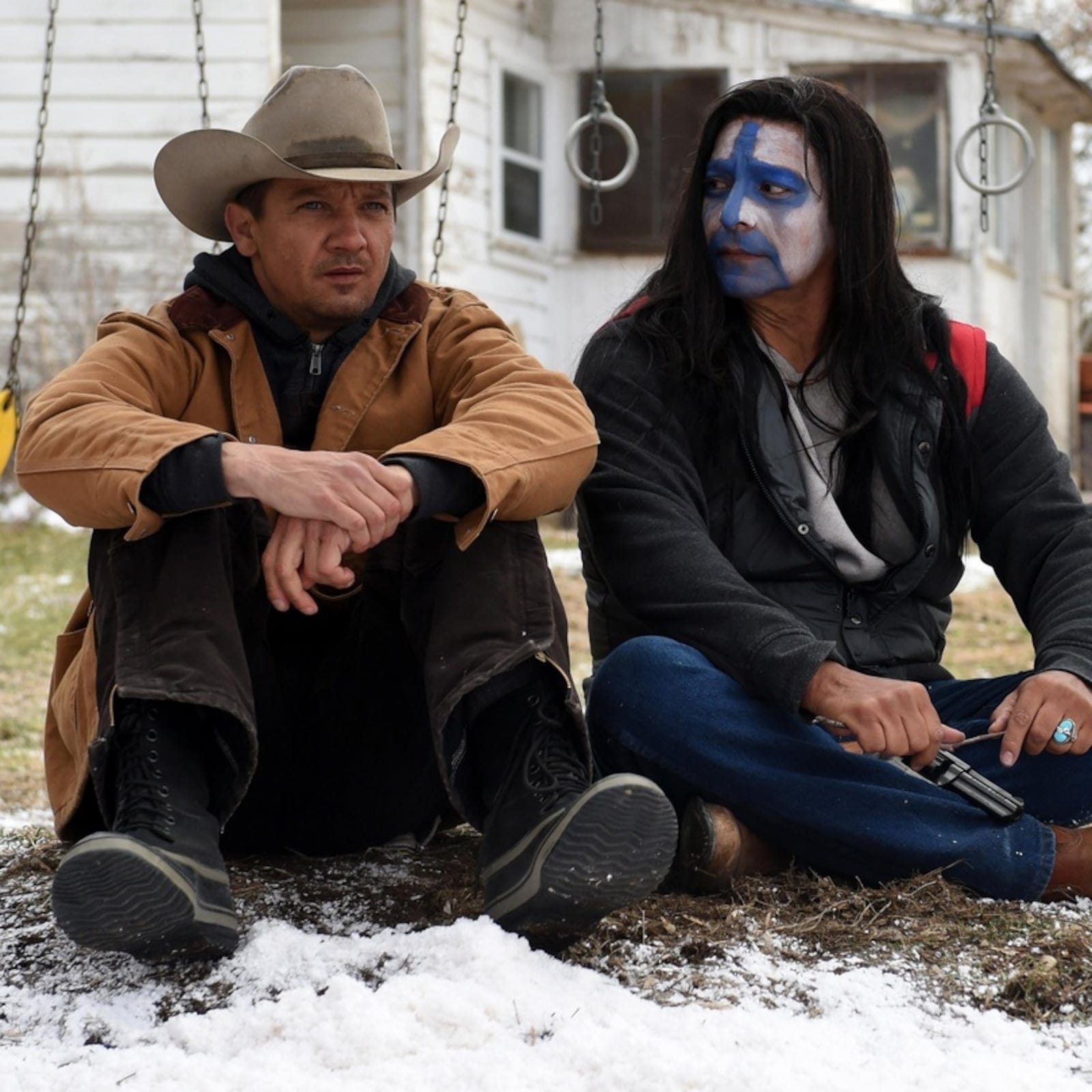
So you have a reasonable framework for a series of murders that have occured, murders that began with sexual assault and ended on rough terrain. Enter FBI Agent Banner, who believes that foul play connects these deaths out on the ice. The audience pulls close to her, because she is played by Elizabeth Olsen, and is always on the verge of tears, even when she smiles. This is a procedural, so it will take Cody’s survival skills and Banner’s investigative talent to uncover the perpetrator. Gil Birmingham is powerful as the father of the deceased, and, as expected, the late Graham Greene has considerable presence as a local cop. Each person collaborates with each other (until they don’t…) to find out the truth.
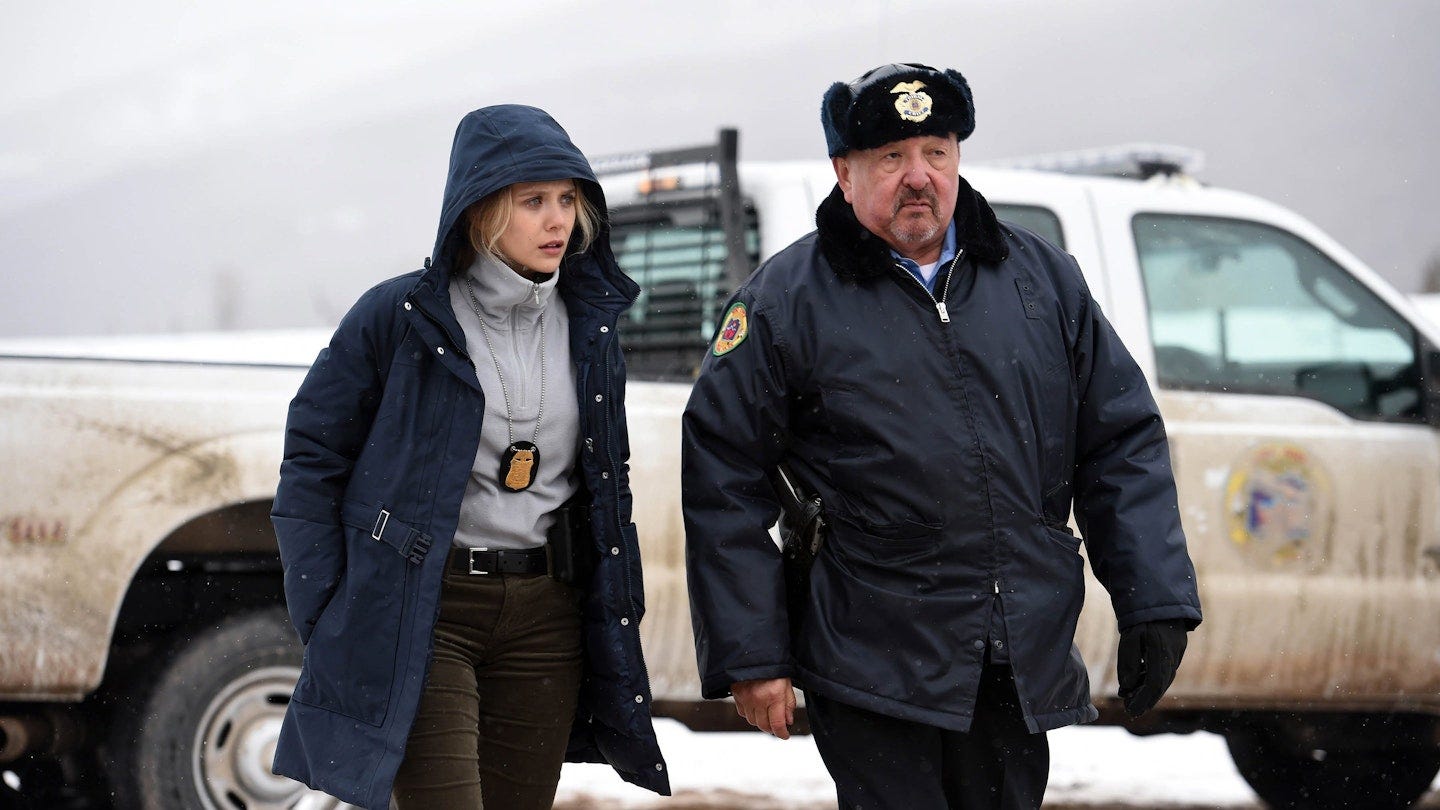
But it’s impossible to shake how the movie is more interested in these two white outsiders, Cory and Banner. There is no romantic connection between the two, but it’s a need for the plot that these two see eye to eye. You get the sense Sheridan is trying to find the humanity in these Native characters not in life, but specifically in death. The corpse that begins the movie is Natalie, and she’s a dead body for the bulk of the runtime. Which isn’t entirely egregious until we meet her in flashback, and we witness her last moments, where she is, first, arm candy for Jon Bernthal, and then, a victim in a grisly scene of sexual brutality.
“Wind River” builds to a surprisingly-potent action finale, and it puts a genre-movie cap on a story of tragedy and redemption. As much as Sheridan wrestles with representation and class hierarchies in his work, he still shines in his effort providing simple, exciting solutions to complicated storytelling problems. I’m not really sold on Renner as a leading man – he’s been solid in a few roles, but in his final scenes, I think he’s going for a Bronson-type presence and doesn’t deliver, failing to punctuate the film’s violent dramatic closure. But like most of “Wind River”, he’s good enough. You don’t see a lot of murder mysteries set on the reservation. Maybe the next one doesn’t need white people.
Sheridan was riding a considerable hot streak around this time, having switched careers from acting to writing and directing. 2015’s “Sicario” was a surprise hit and received three Oscar nominations, for Best Cinematography, Best Original Score and Best Sound Editing. Sheridan also wrote the David McKenzie-directed “Hell Or High Water”, which I recall we watched in prison on Election Night 2016. He received a nomination for Best Original Screenplay, and the movie was also recognized in the Best Picture, Best Supporting Actor (Jeff Bridges) and Best Film Editing categories.
Having written two movies that collected a total of seven nominations, it makes sense that Sheridan stepping into the director’s chair for “Wind River” would be an Oscar play. “Wind River” even landed in the hands of a distributor known for its illustrious reputation at the Oscars. Unfortunately, that studio was The Weinstein Company. At the time of its home media release, near the start of an awards campaign, “Wind River” was passed onto Lionsgate, and a few months later it was shut out of the Oscars completely. It’s interesting that Sheridan eventually moved onto franchising. Not only did he shepherd “Yellowstone” into becoming the biggest brand on television and streaming, he also penned a second “Sicario”, with plans still in place for a third. Until recently, there was also talk of “Wind River: The Next Chapter”.
I want to keep reminding people how we, as a society, talk about prison. Even when we disagree with it, when we fight it, we talk about it like it’s an institution that’s worthy of respect, one that, regretfully, simply makes mistakes. We do this because we do not want to confront power, power that in this case is malfunctioning, and failing to serve the interests of the less powerful. In a way, I have been guilty of that too. When I was down, I endured experiences that made me think via a variation of, “They’re treating me like a prisoner.” I was a prisoner, I had captors, I was in custody – even then, in my mind I spoke in euphemisms, because I couldn’t always bring myself to grapple with what these institutions mean, what they do to people, what they were doing to me.
I think it’s important to note that they murder people. People die in custody. It should never happen – don’t let anyone tell you about percentages and proportions, because it shouldn’t happen at all. They’re tasked with caring for you. And indeed, if you were at least half-smart and half-lucky, you leave prison in better shape than as you entered it. I walked out of prison fit, youthful, even on the cusp of forty. Prison keeps you from the outside world, it preserves you. So the idea you might die in custody is wildly reckless. I’m seeing it more with those in ICE custody, because moreso than federal prison, ICE detainment is about cruelty, about dissuading immigrants to keep America white. This detainee died in a facility just a few miles away from where I’m currently typing this, an institution that the federal government illegally deployed as an ICE facility despite being denied by the state. New Jersey claimed the facility was not fit to detain anyone at the moment. In addition to the many escapes reported already, proving their point, the man in the above link is said to have “fallen down the stairs.” Whichever narrative that you believe – that he actually did fall (as in, the facility is unsafe) or that he didn’t really fall (which means ICE is lying) – reflects poorly on this system.
When you are in custody, there is a responsibility that your health and safety is maintained. Which is why it should be said that ICE killed Jean Wilson Brutus. They murdered him. And people are being murdered in custody all over the country, both in ICE facilities and in prisons. This is not an attempt to demonize people, it’s an attempt to use the right words, and to designate responsibility towards the right direction. They have the power to place people in boxes and then distort and trigger the boxes to allow harm. So when that causes death, we should recognize what it is. Call it murder. It’s more honest than a euphemism.
Absolutely call it murder.
And speaking of using the right words, I think we should be referring to them as concentration camps rather than detention camps.