
Truth
And Why Police Shoot

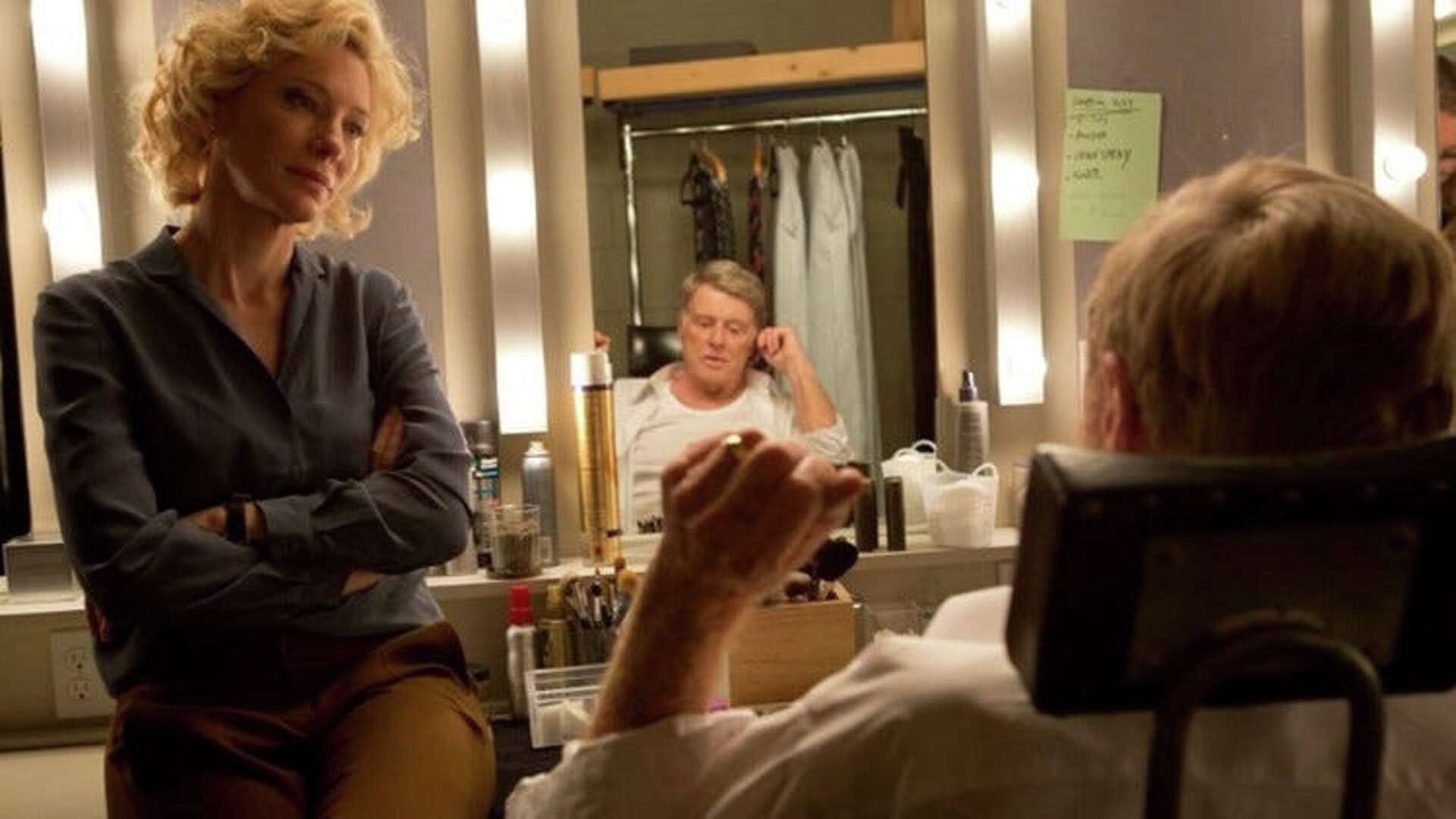
There’s no way to sugarcoat this. James Vanderbilt‘s “Truth” is a movie that feels like it comes from a totally different era. We might as well be watching cavemen carving doodles on the wall. This is a film, arguably forgotten, about inside journalism, released about a decade ago to a very different America. It focuses on events from 2004 or so. It talks about a different world, one where scribes, particularly ones who work at CBS, are tasked with discerning whether or not certain allegations were true or false, journalists trying to find out if there is a reliable source for what they believe, and humans trying to understand if there is an inherent truth underneath interpersonal and professional chaos.
The topic is George W. Bush. Though he spent time in the military, that period has always been fraught with questions regarding the nature of his service and the corresponding behavior of his superiors. These journalists are driven by the possibility that the public has been lied to regarding Bush’s military records. But to be fair, they’re also looking for the white whale – the story that could sink a presidency. See, back then there was a concept called “shame”, and it could somehow emerge from a President who participated in an affair that seemed, if not illegal, then immoral or improperly handled. We were such strange people back then.
“Truth” is pretty even-handed, I’d say, in acknowledging that part of the pleasures of working in this field are the chance for advancement or self-aggrandizement. You get the sense that these people, high up above their socio-economic perch, aren’t affected by a Bush presidency, so if Al Gore was the President and they had something damaging on him, they’d chase that story too. Instead, this is how Bush indeed might be stretching the truth about what was cushy military service, and how brass protected him from evaluations and mandates. Specifically, there’s the matter of 1972, when Bush’s presence was unaccounted for. Did he go AWOL? “60 Minutes“ producer Martha Mapes (Cate Blanchett) and her reporters think they have a lead.

“Truth” then details the anatomy of a story. When you’re relying on sources, you’re relying on trust. Everyone is making a deal with each other. You may have documents, but those documents need to be verified. And verification relies on finding someone who will tell you something you believe is true. The reporters stake their reputation on the source. And the source in question risks their credibility by trusting the reporters. At the very end of the scale, this chain of events has to be deemed reliable by the person who will report them. In this case, it’s Dan Rather (Robert Redford) the theoretically most-reliable name in news. Vanderbilt quite skillfully examines this rope-and-pulley apparatus to showcase exactly where the system works, and what sort of flaws are clogging up the machine.
CBS reports the story and the then-infant right wing media machine stirs. Radio hosts, newspapers, anyone who might have a vested interest in the success of George W. Bush, start firing back, based entirely on “whims” and “vibes”. Mapes holds steady, unimpressed, but the executives at CBS let them know just how many other outlets are reluctant to treat CBS’ findings as fact. You could say that this is yet another example of the illiterate outrage monkeys on the right immediately springing into action at every provocation – if you doubt this is a right wing problem, turn on any talk radio station right now and listen for forty five minutes. An hour if you can take it, but you can’t, be real. Of course, the story, and “Truth”, are both not so simple. The paperwork that attests to their findings is flawed, featuring anachronistic spacing and formatting standards you see in modern computer technology. Now pressed, their sources recant, or their recollections get shady. After the fact, it’s no longer enough to build a reputable story.
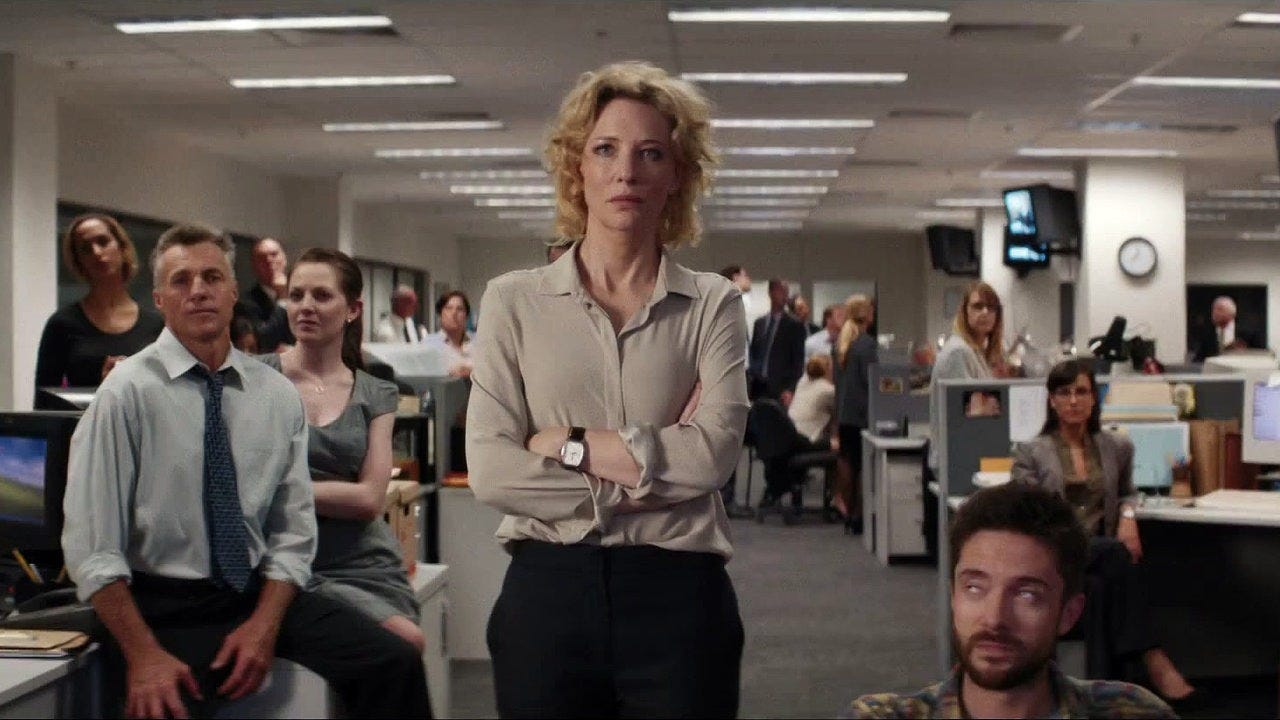
Now you get to the structure of the attacks. The media denies the narrative. Slowly the media disproves the narrative, just enough that they can declare the affair debunked. And then there’s the revenge tour. Mapes becomes the sacrificial lamb, as her own left wing beliefs are targeted, most notably by her own father. This becomes acceptable gamesmanship – finding a disapproving family member to randomly debunk the accuracy of an unrelated story. This journalism can’t be true, this woman has a terrible relationship with her conservative father. As scummy as this is, this was STILL a kinder era of politics, as the collective indifference for family members’ naked disdain for the current President doesn’t seem to move the needle. Now Mapes has to deal with the alleged confirmation bias that clouded her judgment, as if working at the highest rungs of corporate journalism back then meant you somehow kept childishly playing favorites. I guess that’s changed too.
“Truth” looks at the public and the private fallout of these circumstances as well. Rather, the top name in news back when that was an actual distinguishing trait within the media, lost his position. It’s intriguing, something of a moral wrinkle, that Rather walked the story back on-air, but otherwise remained supportive of Mapes and her team. The film is cagey: was he backing his people in the face of obvious corporate/political pressures? Or is it possible that he still believes the story, and cannot admit to himself his own bias? Fittingly, in real life, he has since spoken out of both sides of his mouth regarding the story, claiming that it was inefficient journalism, but that the accusations were true. I don’t believe that’s in the movie.
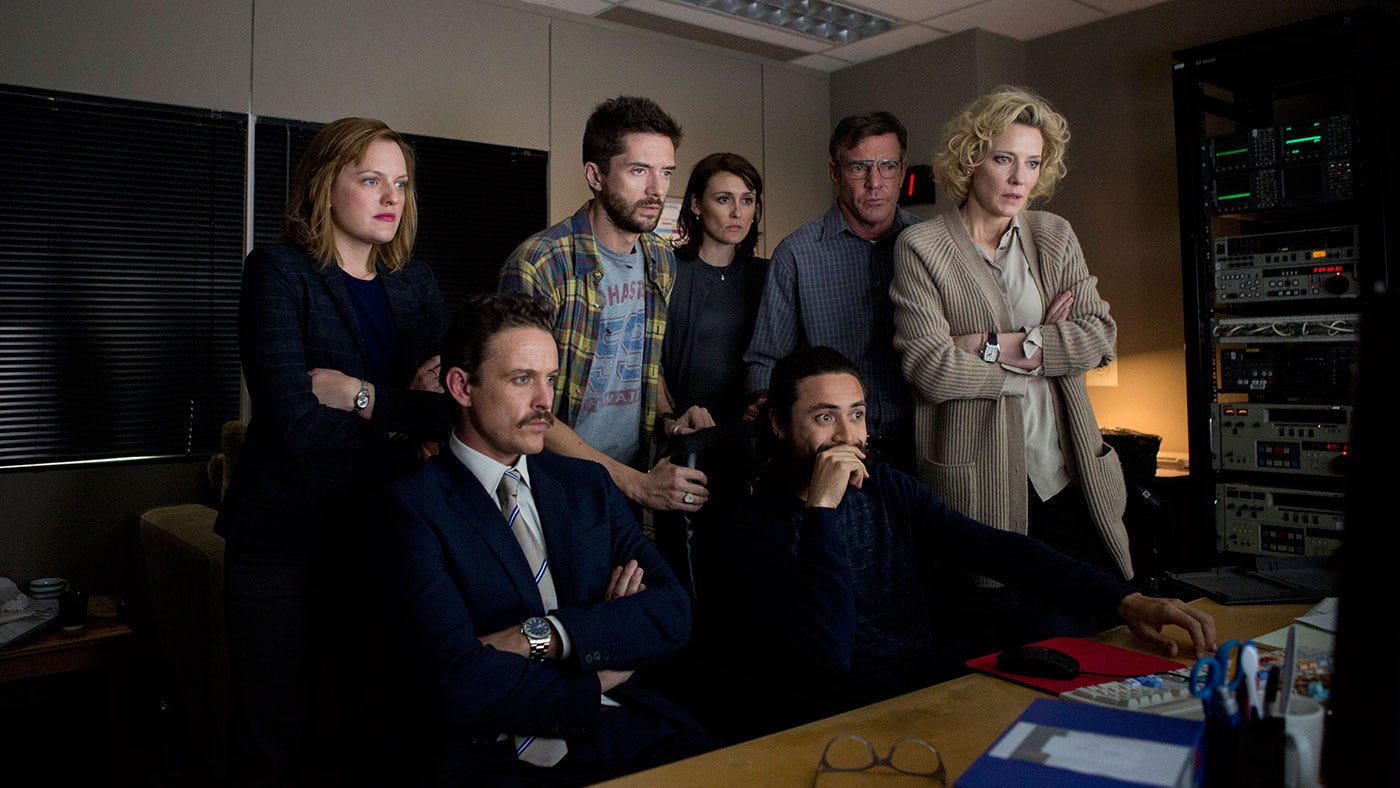
Redford is quite good in the role, even though the movie keeps him at arms’ length. The pressure largely falls on Mapes, and Blanchett, well… when is she not compelling? She’s quite powerful in the role as a woman who takes it on all sides as the person responsible for the entire fallout – again, Rather sued CBS in real life, in a case that suggested he was being made the scapegoat for Mapes’ errors. It’s compelling viewing to watch these two excellent actors play two principled people. Of course, one of the characters who ends up being a rather loud mouthpiece for the movie’s agenda is another producer, Mike Smith, played by Topher Grace. I don’t think it’s a slight to suggest that Grace simply isn’t in the same class of Redford and Blanchett. But when he blows up in the third act, calling into question the corporate relationships that CBS has and whether their motives are that noble, he makes you think this is less about a real theme and more about being agit-prop cinema. Grace’s showboating is entertaining, but it calls into question the integrity of the entire piece much louder than anything in the first two acts. “Truth” is a movie from which you will learn a lot. Some of it, they tell it to your face, quite loudly.
Why do police officers shoot? Why do they use deadly force? The answer is different every time, though there always comes a point where, if the cop survived a shooting incident – and he likely did if he’s the first to fire – he will have a chance to explain his reasoning. Because police officers have unions, who are very much dedicated to policemen being able to maintain their jobs in the face of adversity, they are coached and taught what to say to avoid scrutiny. Which is why you’ll see the same rationale regarding a fear of bodily harm. I remember when an officer falsely accused me of assaulting them in prison and I was taken to the Lieutenant’s Office. Once they saw I posed no threat, and that I had absolutely no clue what the officer was referring to (let alone any ill will), they let me go. It was then when the officer revised their accusation to include the words “I feared for my life”. I spent three months in the SHU for that alleged fear. A good phrase to keep handy.

I’m assuming that you have read about the circumstance where this police officer in Mississippi fired on a couple of alleged shoplifters and killed a one year old boy. I’m not certain what the defense was here, but I’m also not certain which one would apply. For one, in case of shoplifters, why are you taking your gun out? You’re gonna fire shots for the sake of the local ShopRite losing money? Would you be serving the public interest, or would you be serving corporate interests, enough that you’d fire a gun? By the way, the item witnesses say was being taken were diapers. Sure, diapers, fire away, Dirty Harry. Secondly, the officer got a good look at the perpetrators. It can be strongly inferred that they were aware a child was present, in which case, put your damn gun away.
Third, the allegation seems to be that, since he fired at a moving vehicle, he was alarmed that the vehicle was driving towards him. Look, we’ve been over this many times already. Shooting at a moving vehicle is not protocol, especially if it’s coming from a heavily-populated area like a supermarket parking lot. It’s a great way to recklessly be responsible for the deaths of several bystanders. I ask you, when you have cops shooting one year olds because of diapers, does it seem like an isolated incident, or a fundamental systematic problem that requires immediate reform? The victims of the shooting – the driver of the vehicle was also hit – were Black, so how quickly do you think reform is going to happen? Oh, I’m sorry, it’s my fault for noticing obvious patterns, right?
Next week, we return with five days of SUSPENSE.
“the illiterate outrage monkeys on the right” I enjoyed the part in last year’s Superman where Gunn portrayed this literally. As for the police and shooting and truth…. I hope we do not live in a post-truth world ie where anyone can lie and it doesn’t matter. But hope is the fool’s friend (a line I got from House of the Dragon).
What I will say is that we can’t give up fighting for truth - that so much effort and time and money is still being put into propaganda and trying to distort reality and win people over to a particular distortion, all shows that opinions still matter, even if truth is no longer something we can agree on. To paraphrase Humpty Dumpty in Alice in Wonderland, the question is not what is true, but who has the power to make words mean what we want them to mean.
I’d argue this is how things were before this brief, almost unicorn period in the twentieth to early twenty first century when we thought (perhaps falsely) that it was ever anything but.