
The Wandering Earth
And Incarceration In The Distant Future

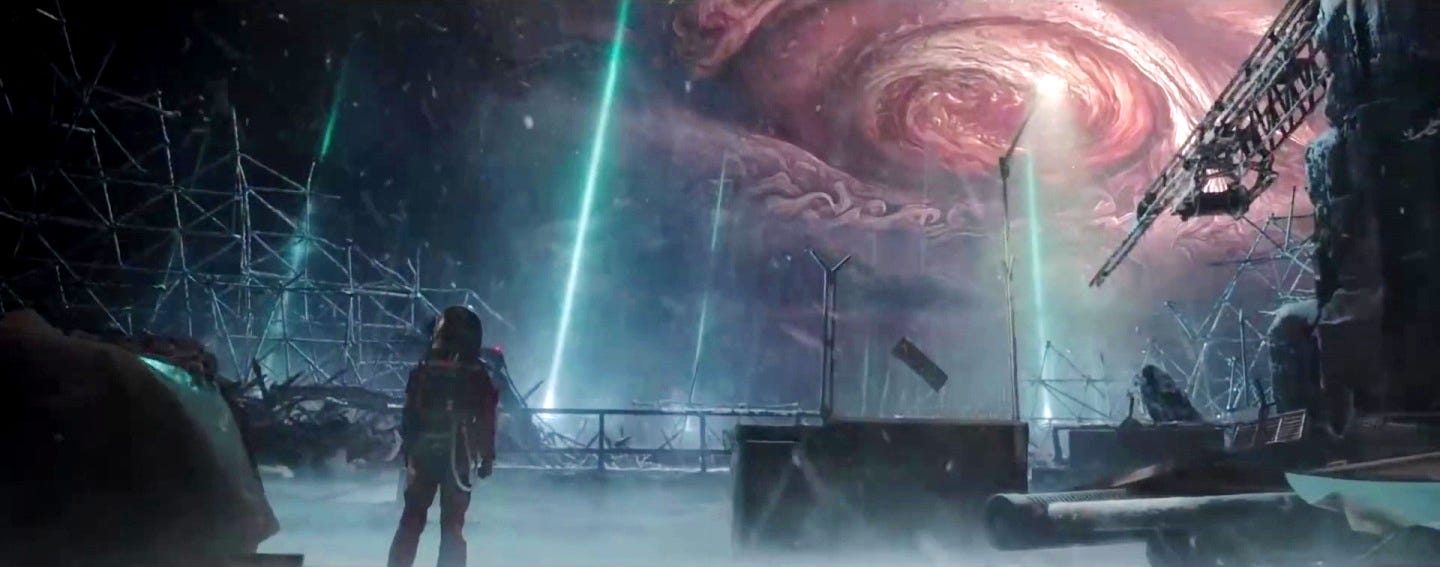
While in prison in 2019, I was able to obtain a list of the highest grossing movies of that year. That was a crazy twelve months for the industry, with nine billion dollar movies. But a little bit down the list was an interesting anomaly. Among the twenty highest grossing movies of the year, four of them were Chinese productions. “The Wandering Earth” alone grossed $700 million, only $5 million of that coming from America. By contrast, this summer Warner Bros. is hoping that their big “Superman” movie can crest $700 million.
There has been a lot of discussion about China’s growing film market, which has in many ways surpassed America’s. Which makes it amusing that “The Wandering Earth” feels like a cocktail of the best and showiest sci-fi blockbusters in recent Hollywood history. Yes, this is a movie that captures the feeling of relentless in-camera chaos you normally see in the hyperviolent work of Michael Bay. But there’s also feints at attempting the elegant choreography of something like “Gravity” or the ambition of stuff like “Avatar”. “The Wandering Earth” barely played in America, but if American audiences weren’t so allergic to global cinema, this movie could be reasonably entertaining to the mainstream.
The film’s hook is an impressively ridiculous one. In the distant future, the Sun has begun to grow disproportionately, threatening all life on Earth. Thanks to the ingenuity of seemingly exclusively Chinese scientists, the plan is to strap some massive rockets to our Big Blue Pearl. That’s right, Earth is about to become its own massive spaceship, exploiting the gravity of Jupiter to swing into a new position within the galaxy, further out of the way of the Sun. For all I know, there may be actual science behind this. The source material is a story from Liu Cixin, who also wrote “The Three Body Problem”, which I read and understood almost nothing, because I’m a big dummy. Seemed like a smart book!

It’s interesting to see what the Chinese spotlight as an aspect of their blockbuster storytelling compared to a domestic filmmaker. An American film would have a “no one left behind” attitude, which would probably be improbable and wasteful and, within the movie, show that the heart always triumphs over the brain. A dangerous fairy tale, in other words. Here, half the population wins a lottery to travel underground, leaving the remaining humans on Earth to die horribly. The rest of the film pivots around this tragedy as if the practical decision was undoubtedly the best one. Like a lot of American blockbusters, there’s a generous dollop of whimsy and comedy, an odd fit considering those that made the “sacrifice” of not winning that lottery.
But this is the overwhelming notion behind these Chinese crowd-pleasers, which are made specifically to fortify the relationship between the audience and the state. And part of a deference to country involves sacrifice. Which means the surviving characters tasked with keeping the Wandering Earth moving are upbeat about this supersized version of national service (there are allusions to relationships with other regions, but we mostly see Chinese heroes – there is a Russian soldier who shows up to be a sacrificial lamb and maybe a vague reference to Peter Stormare in “Armageddon”).

You see that in a lot of nationalist Chinese blockbusters (I’ll be discussing a few as this substack continues) but it’s comparatively downplayed here. I may be being backhanded when I say that this one is passable as far as rhetoric. It’s a big, colorful space adventure with Big Screen Heroism and implausible but cheer-worthy heroics. You never get too attached to any major character, and before you can stop to critique the physics or logic of a certain event, here’s another one hurtling towards these characters. This runs over two hours, but it never actually drags.
Part of this might be coming from my love of special effects in foreign blockbusters. I hate how most American blockbusters create these massive CGI visuals but remain tethered to one accepted reality, rendering many sights colorless and of a dulling consistency. There are grown men and women paid a hefty sum to sit in a room and ensure that the skin and wardrobe on evil alien Darkseid from Apokolips looks “realistic.” When that can’t be accomplished, American animators settle for sludgy sights, sometimes covering up their own work with further CGI shadowing.

But in foreign films, they seem to have no interest in how an effect resembles an actual real object. The birth of elaborate CGI occurred in the 00’s, more or less, and filmmakers outside the US were late adapters. Once they were able to create visual effects blockbusters in their language, compromises were made as far as the basic quality and consistency of that work, but they’ve patched that up with imagination. It results in truly bizarre cinema like Russia’s English-language “Branded” (see trailer below), a warped Harry Potter variant about evil advertisements that pixelates it’s building-devouring CGI menace in a way Hollywood wouldn’t get to until years later in the flimsy Adam Sandler vehicle “Pixels”. These movies aren’t afraid to look weird. “The Wandering Earth” has a few really impressive FX shots, and also a few that don’t match their backgrounds as far as shadows and matte work. But what they sometimes lack in realism they make up in loud, popping colors, the kind of stuff every filmgoer wants to see.
I’ve talked way more about effects than I have the overall plot because, inescapably, this is a dumb and corny movie. C’mon, you knew that going in. But “The Wandering Earth” loudly announces that China may be better at this than their own inspirations. Shortly after “The Wandering Earth” was released, Roland Emmerich (who inspired several Chinese blockbusters with his output of big, earnest disaster movies like “Independence Day” and “2012”) debuted “Moonfall”. “Moonfall” is an aggressively, almost parodic stupid sci-fi would-be blockbuster with similar plot elements to “The Wandering Earth”. Not only does “Moonfall” try to capitalize on its bonkers premise of the moon literally falling into the Earth, but halfway through it reveals that the moon was actually a superstructure built by an alien race, or a.i., or something ridiculous like that. In performances, dialogue, execution and even special effects, “The Wandering Earth” clearly topples “Moonfall” (which made over $630 million LESS than “The Wandering Earth” despite being, I admit, 100% funnier). There’s a second “Wandering Earth” I haven’t seen – can anyone vouch for it?
I think a lot about how space travel, should it happen one day for the rest of us, involves inevitable society-building. If we were to follow the mad-king tech-architects of our world and colonize Mars, we’d have to establish what kind of world Mars should be. What will be our currency? What will be our food, and therefore our diets, and what will become of our health? All worthy questions. It’s one big re-do of what kind of world we occupied previously. We should try to do better next time, right?
So what will law enforcement look like? Will this new society have prisons? What will we do when we violate the new social order? This is a crucial question, and I wish it was considered more explicitly. Because someone will be an architect of this world, they’ll have to include “government” buildings, and libraries, and schools. Necessities, it would seem. “Prisons” should not be viewed as necessities, and we have to stop anyone who thoughtlessly concludes otherwise. Restorative justice will be the mark of a more evolved society. One day, maybe our grandchildren, maybe great grandchildren, will be there on the day someone announces the plans for a new world. And when it includes jails and prisons, they need to forcefully, and repeatedly, ask the question, “Why?”
I really liked this goofy movie, but you're right, it's no where nearly as funny as Moonfall.
Honestly If there was a scene in Wandering Earth where someone goes to a deserted basement and discovers Donald Sutherland (or his Chinese equivalent) playing the man who lives under the stairs, I would've enjoyed it more.
I know it was made too early to qualify for an article in this Substact, but have you seen Danny Boyle's Sunshine? If yes, dud you like it?
Great review! I’ve never heard of this movie, but glad to learn of it.