
The Truth
And Not Writing A Book

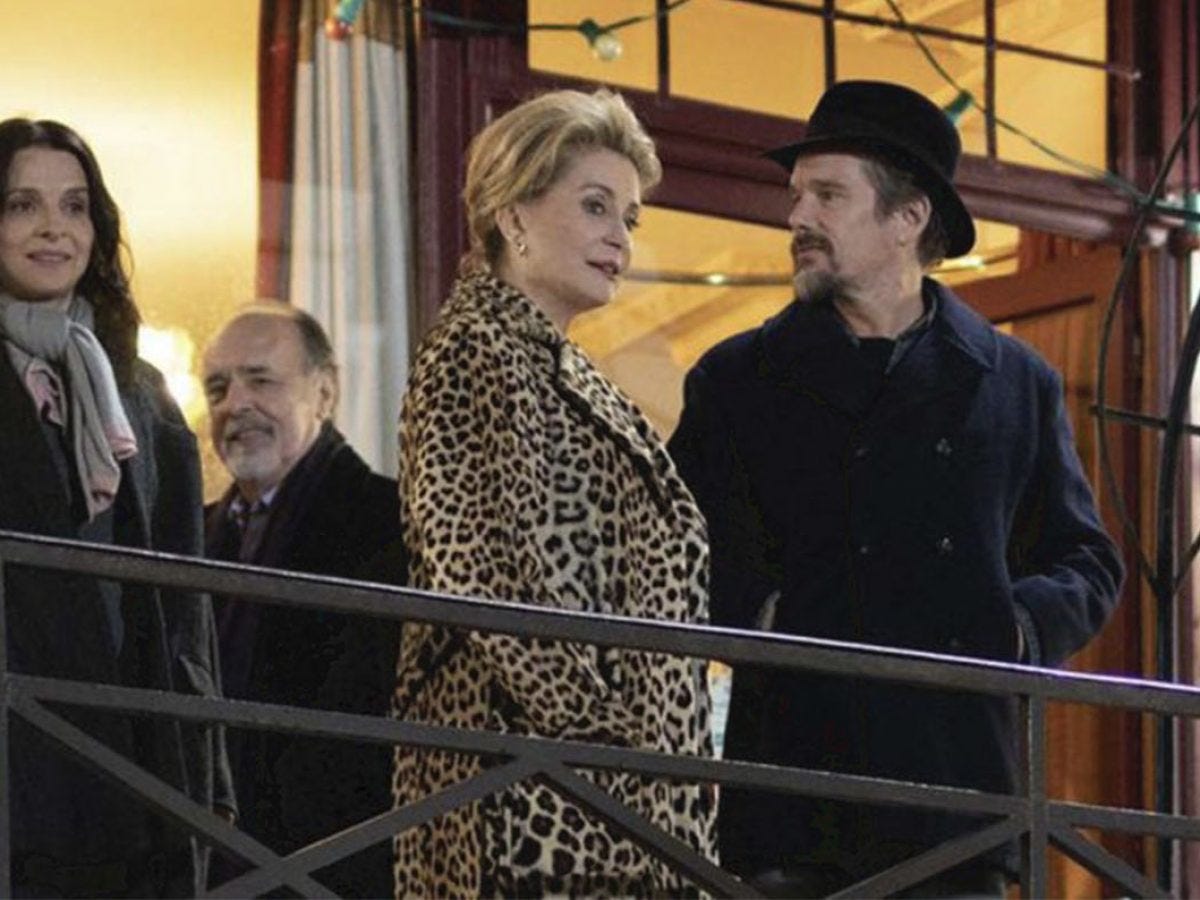
There’s a funny moment in Hirokazu Kore-eda’s “The Truth” where one character asks another, “Do you love yourself, or do you love film?” The gag is that the question is being posed to a character played by Catherine Deneuve, THE Catherine Deneuve. Of course she haughtily responds, “I love the movies that I’m in.” But you half-expect her to turn to the camera and say, “Hey, people, I’m Catherine Denueve! I AM film!” “The Truth” expects you to carry at least a little bit of baggage into the movie, acknowledging that this is Deneuve, “Belle Du Jour”, “The Umbrellas Of Cherbourg”, “Repulsion”, a resume that goes back sixty years and never stops producing greatness. Film lovers should begin watching a Deneuve movie with a mandatory prayer/offering of gratitude.
“The Truth” is a treat for the cinephiles, it’s a movie made from a film buff’s fantasy draft. You have Deneuve playing alongside Juliette Binoche, another legendary French leading lady of a different generation, two titans from different eras squaring off. Representing the American contingent is the great Ethan Hawke, probably the one American actor with the most European resume in that he’s been a leading man in a number of different types of films across a vast genre variance. Directing this is Kore-eda, a Japanese auteur working for the first time not only outside of Japanese, but with a film that flips casually between French and English.
Deneuve here plays the deliciously-named Fabienne Dangeville, a cinematic legend not unlike Deneuve. Before we’ve even gotten to meet her, she’s tossed off an insult about another actress to an interviewer – when she’s given the opportunity to recant, she suggests that it’s alright because the actress is dead. The actress, for the record, is not dead. Fabienne’s loose tongue has benefited her because she’s about to release a memoir, one that the cinema world waits on. Also waiting on the book is her daughter Lumir (Binoche), hoping to add perspective and flag offending passages, knowing how free her mother is with, well… check the title.
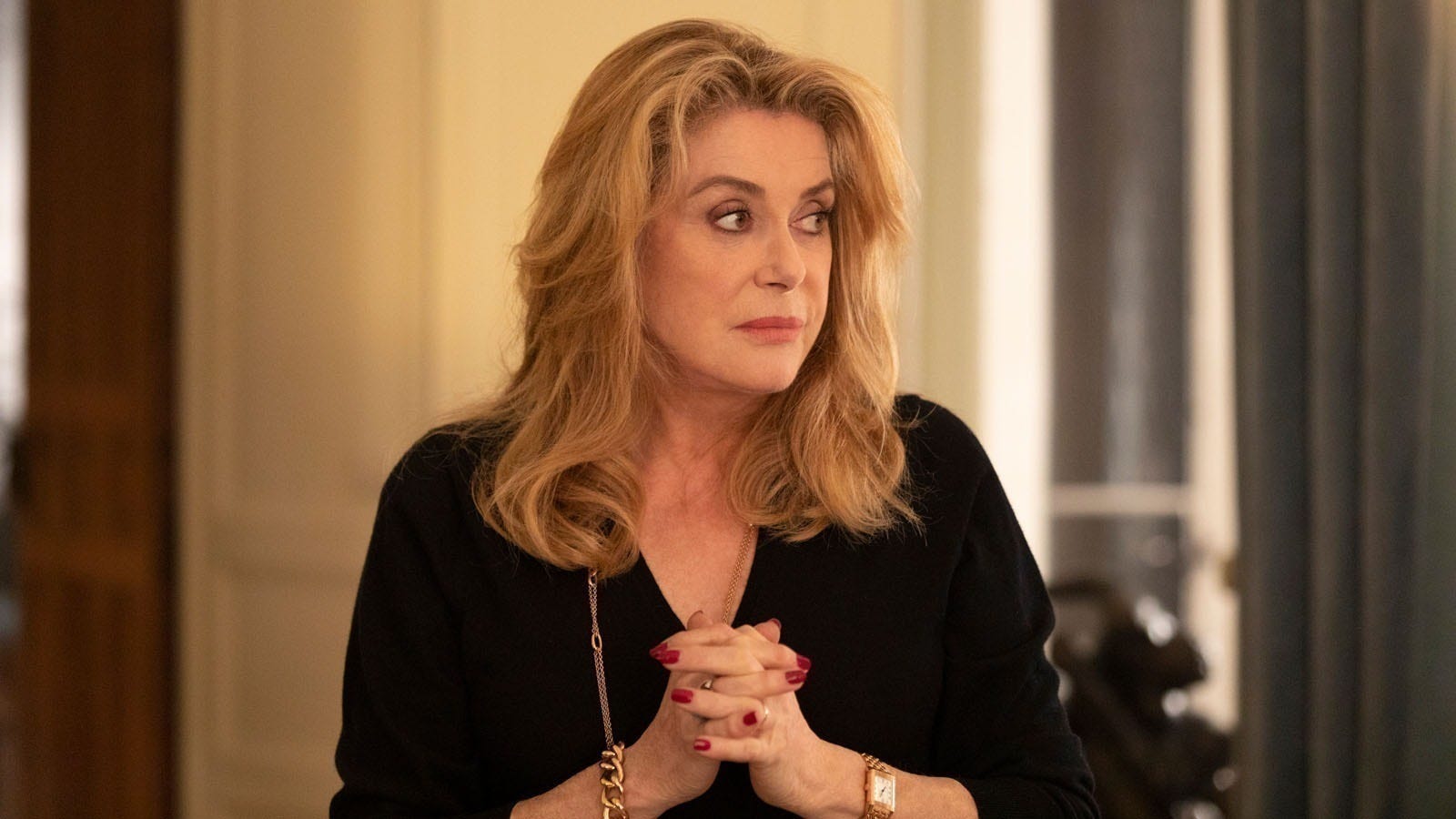
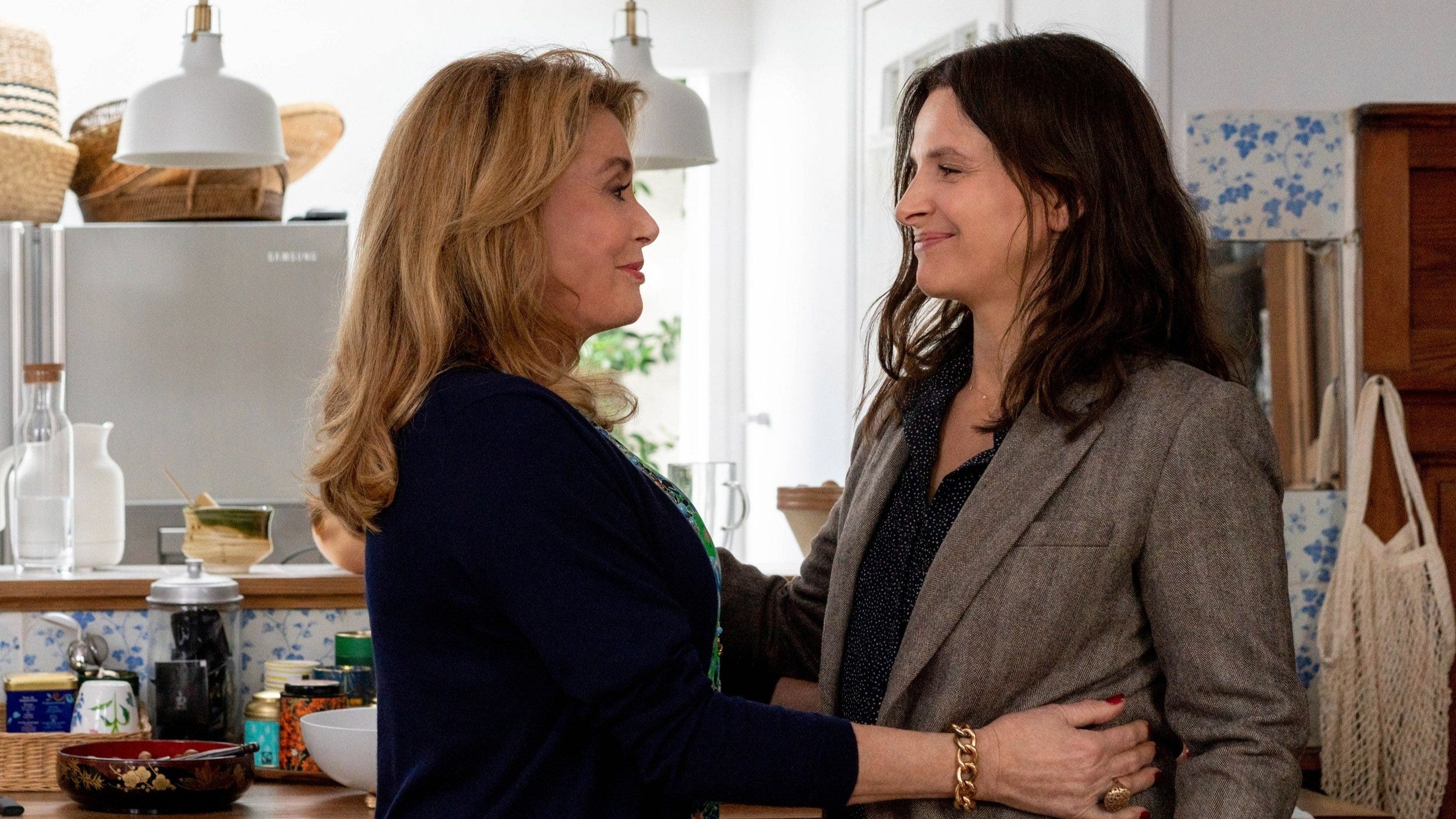
Of course, the book is b.s. Lumir can’t get over how her relationship with her mother is depicted. But it’s important that Fabienne remain in charge of the narrative, to the point where she minimizes entire crucial relationships. Lumir’s estranged father? Apparently dead, in spite of his sudden presence in Fabienne’s home. Fabienne’s lifelong manager and, essentially, butler? He’s barely mentioned in the book, which gives him a great reason to quit. Which then turns Lumir into the temporary (?) help. And suddenly Fabienne is complaining to Lumir that the tea is too darn hot.
All the while, Fabienne is acting in a new movie. It’s a legacy role, in that it seems to pit her against a young new starlet, but it also has her playing, through sci-fi machinations, a mother and her daughter. Something like that. The point is that it’s a silly mirror of Fabienne’s wrestling with Lumir’s role in her life, which Lumir feels the need to question. Fabienne is not taking this de-legitimization well. She expects to be the center of tension on set, but she isn’t. She expects to be waited on at home, though that’s no longer happening. More importantly, she’s seeing her book as her legacy – the idea of everyone questioning her recall feels very much like everyone is calling her a liar. And maybe she is, but that’s besides the point, dammit. She’s Fabienne Dangeville!
Because I’m an ugly American, my eye kept drifting over to Hawke as Hank, Lumir’s actor husband (the idea that Lumir became a writer but married an actor raises all sorts of questions as to her relationship with the written word and her struggle with her mother’s career). Hank doesn’t speak French, though he gets along with Fabienne quite well. Possibly because he knows his place, completely outside of this complex family drama. Possibly because, as an working actor, Hank is starstruck by his mother-in-law. Hank’s acting career is only now showing signs of life at a later point, so he’s absolutely gleeful about this glamorous rendezvous, at the moment when he’s finally becoming someone. He’s struggled enough that he knows when to speak, and when to be spoken to. Also, a helpful reminder: we’re talking about Catherine Deneuve here.
Hank doesn’t factor into many of these circumstances, but he’s always in the back, frequently playing with his adorable daughter. I think people today call this being a “girl Dad” even though it seems he’s just being a “Dad”. He’s so aggressive and rambunctious (and altogether sweet) that Fabienne almost treats him like a favorite family pet. The fact she wonders out-loud to her daughter whether or not he’s a good lover reflects how unthreatening he is. Which should be a source of drama, but it’s refreshing that Hawke is simply A Guy Who’s Around. When one particular dinner ends up being over-stuffed with men from Fabienne’s past, Hank is humiliatingly forced to sit at the kid’s table with a bunch of five year olds. And it looks like he’s having the time of his life. Like much of this measured, thoughtful and peppy little movie, it feels infectious.
A lot of people came to me after prison and suggested that I write a book about my experiences. I’m pretty sure it would come about a lot like Fabienne’s – a lot of mistruths, a lot of favorable recollections of moments that otherwise were unflattering in retrospect. I’d be conflating experiences and people and at some point I’d get tired of devising fake names. And I’d probably say something ridiculous enough to get me put on a government list I might already be on thanks to this Substack. The negatives, in many ways, outweigh the positives.
I am lucky. For every ugly story I’ve told here (I’ve shared a few), there are a couple I’ve forgotten, maybe willingly. It feels like my subconscious has moved to erase certain memories I’d rather not have in order to preserve my sanity. I’m not sure how many people do so much time in prison like me and get out sane and… I don’t want to say well-adjusted. Maybe just adjusted. It has long been important to me that, in polite society, I did not come across as someone who has been to prison. Part of that stems from the fact that every jerk who goes to prison thinks they have a book in them. I suffered, but so did others. I ultimately knew less than others in prison, because when the time was right, I kept my head down and knew how to move. If you know how to move, you can either run a prison yard, or disappear within it. If you don’t, there’s always an opening as a henchman. And I ain’t no henchman. But that definitely limits the color of the types of stories I can tell. I don’t like the idea of getting heat for what I might write. But I also don’t want to tell a story that, through the years, was mutated into not resembling the truth, if only as an act of self-preservation.
As one such person who has expressed hope that you would write a book someday, I stand by it, but now have the sense to specify that I don't mean one based on your experiences in prison.
Simply put, no one I know writes the way you do alongside your breadth of curiosity, wit, and principle. Slam-dunk ideas/concepts are one thing, but you've got a slam-dunk voice. I get your reasons for not wanting to write one all the same, but even so.
I think savvy actors like Ethan take roles that allow them to spend time in great locales with fun actors, and the more enjoyable the role the better.