
Saint Maud
And Firing Squads


This is, I feel, sort of a hot take. But at this point in the 21st century, we’re in the golden age of horror. Even in previous eras where we saw classics, there would be certain factions of the audience that were unreceptive and dismissive to the genre. Now, so many studios build entire horror slates, everyone is trying to launch a new horror franchise, and every year, there are unique and challenging takes on what audiences may find scary. I was in prison for the time when A24 turned horror into a boutique item, and the term “elevated horror” went mainstream as movies like “Get Out”, maybe a grindhouse film in 1979, became an Oscar winner today. We may get a year or two without a true horror classic, but it’s the one genre where filmmakers are consistently encouraged by audiences and producers to take bold leaps.
So glory be to something like “Saint Maud”. I don’t get too bogged down in genre because I’m not stacking videocassette boxes at Blockbuster. But I suppose this could be considered horror, even if the story feels pretty familiar, pretty human, to me. This is the story of Maud, a nurse who takes a job caring for Amanda, a dancer who is slowly passing out of this world via terminal cancer. A prior bad experience with losing a patient has caused a transformation within Maud. Amanda doesn’t need to know the backstory to understand that her new caregiver, Maud, was once someone else.
That someone else was Katie, a person with significantly less faith. Not that we know much about Katie, but Maud is an intensely devout Roman Catholic. In an unfamiliar town, Maud now regularly scans the area for threats and concerns, possibly of her past life. She clutches her crucifix. We soon learn Maud has not much of any social life you’d expect for a young woman her age. Her best friend is Jesus. Or maybe a more vengeful interpretation of his dad. Maud has become a creature of habit – her nightly prayers are intense affairs. She’s too young, but continuing on this path, with her furrowed brow and pursed lips, you seem certain Maud is on her way to a few premature gray hairs.
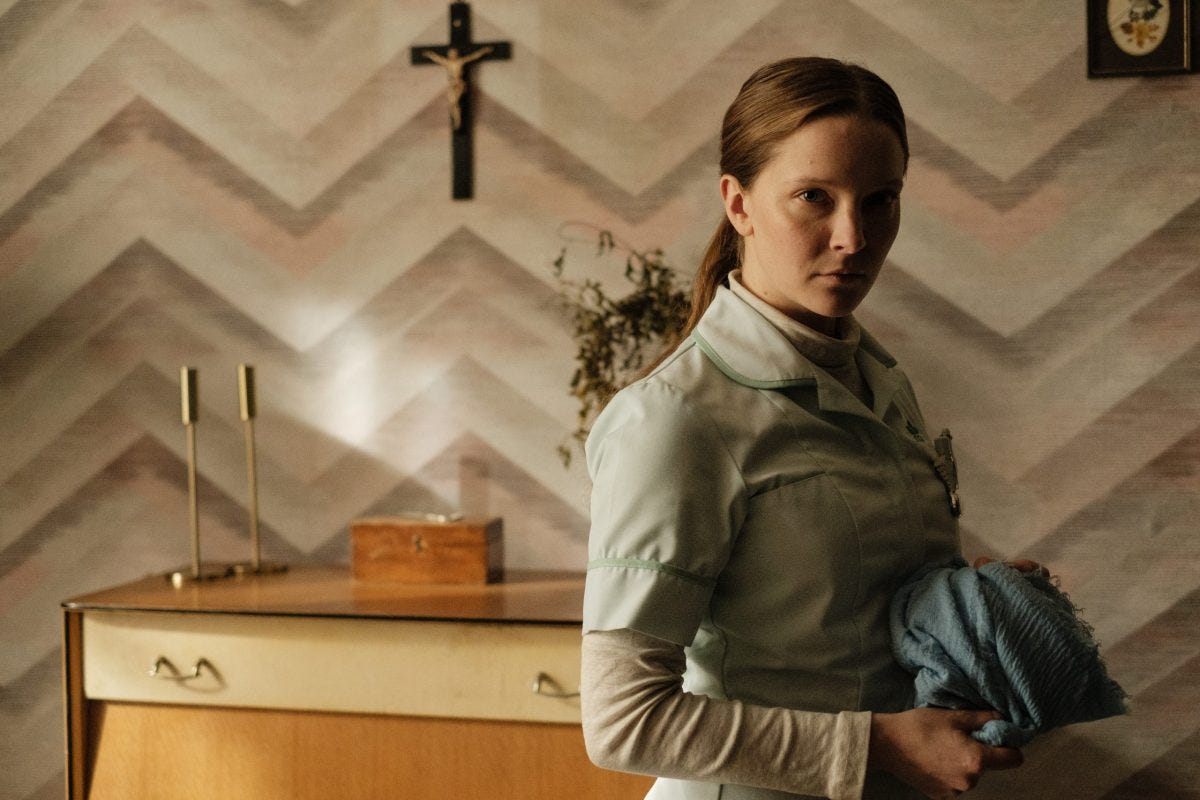
Amanda is a supporting character in this film, but a wonderfully fascinating characterization from Jennifer Ehle. She has regrets in her life, and the pain she currently feels is, she quietly concludes, just desserts. Neither woman realizes that they are in disagreement as to Maud’s purpose. Amanda believes Maud is there to guide her into the afterlife, a hospice nurse who is there to clean messes, provide palliative care, and possibly host Amanda’s friends. She doesn’t realize that Maud is trying to cure her. Not of cancer, but of atheism. In particular, Maud seems to see a connection between Amanda’s disease and Amanda’s homosexuality. Amanda is both aggravated and offended by this, but Ehle plays it with comic amusement. No one will save Maud’s soul from Amanda’s cutting looks, according to Amanda.
But Maud is a fascinating character all her own. Morfydd Clark, an otherworldly presence, seems to lament the fact that she’s so dedicated to her spirituality. To her, she is not merely a devout believer, she is chosen. At the end of every day, Maud looks into the mirror and prays, waiting to hear confirmation of her beliefs. Naturally, she interprets the silence as feedback, whatever feedback it needs to be to consider her thoughts validated. Maud sees visions, dreams, of losing agency of her body, fully becoming a vessel for the word of the Lord. To the viewer, those visuals are troubling, filled with imagery one could consider nefarious, even Satanic. But to Maud, she feels it’s the final step in her spiritual transition. The movie strikes that difficult balancing act of depicting something harrowing, but directly acknowledging what our protagonist’s ultimate success would mean for her. We’re rooting for her, but through Clark’s committed performance, the audience is divided as to whether she can actualize her potential future in a way that doesn’t harm anyone, or if there’s a chance someone, maybe Amanda, can pull her from a ledge. When Amanda meets Maud halfway, is it a comforting show of camaraderie, or is she indulging a very sick person?
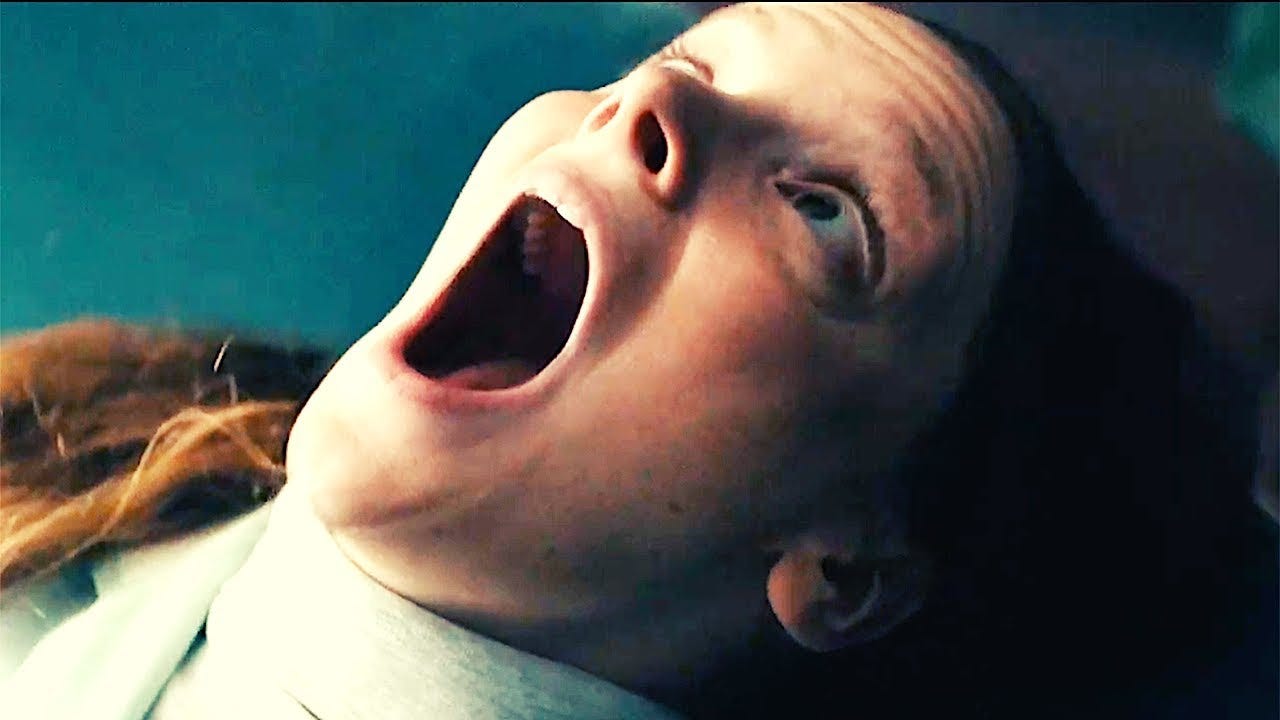
Movies like these challenge storytelling notions. It’s not exactly a revelatory conceit that, as the narrative continues, we trust what we see less and less as we begin to enter Maud’s head. The question is larger than just a narrative, of course, but rather the idea as to whether or not there is a God, vengeful or otherwise. “Saint Maud” begins to spiral into an upsetting finale where Clark further develops Maud into a sympathetic figure without ever making her likable or even, in some ways, rational. The question of faith hangs in the air, preserving a sense of ambiguity. But there is also a very brief moment that seems to definitively answer any questions the viewer might have. It’s not fully endorsed, but it seems like a rather strong suggestion to my eyes. What’s surrendered in ambiguity is rewarded with a vicious punchline. I think it’s worth the sacrifice.
I’m personally sick of society’s obsession with reboots and revivals, and the latest one is particularly distressing. Yes, it looks like we’re bringing back firing squads! There are currently only three people on Death Row in federal prison after President Biden authorized a series of commutations in his final days. But there are forty-four cases in the feds where the Department Of Justice has authorized a pursuit of the death penalty. In case you were wondering, we don’t need to stand on pleasantries – this administration is planning the murder of a couple dozen people. There seems to be no stated rationale as to why firing squads are coming back, other than psychopathic nostalgia. The idea, true or otherwise, was that we stopped using firing squads because we felt we were more humane, less barbaric, we recognized that cruelty was performative and served no other purpose. The current administration’s thought process seems to be that no, we are not more evolved, and why would we be? Frankly, I think it merely reminds us these men are a bunch of performers.

The question does hang in the air: are we more sophisticated than this? We’re talking about federal laws. On a state level, five of them still use firing squads, in Idaho, Mississippi, Oklahoma, South Carolina and Utah. But the feds are merely diversifying a portfolio of murder. They’re also re-approving the use of pentobarbital injections, which were used to kill thirteen men on Death Row during the first Trump administration – the Biden administration eliminated the use. In other words, not only was this a strong priority for an administration that has given the American people a host of real problems, but it’s a branding opportunity, it’s Donald Trump tying himself to a method of murder just as he tied himself to steaks, to real estate, to a fake university. It’s the murder of inmates as a misplaced idea of justice, done with the least regard for the humanity of others. These people are murderers, and they’re not even serious about it.
I put off watching this, but if it's part of the "Golden Age of Horror" we are in, well, OK--I'm in, too.
Love Saint Maud and I really enjoyed your essay. I think the horror works so well because her story aligns so wonderfully with accounts of holy women and saints. I mean, I always find it bizarre that in certain circumstances religious visions are considered perfectly fine and yet in others, they are considered madness.
Maud died at the end. Horribly. But maybe a few hundred years back she'd be considered a martyr.