
Legend
And The Crime Of Hating Capitalism

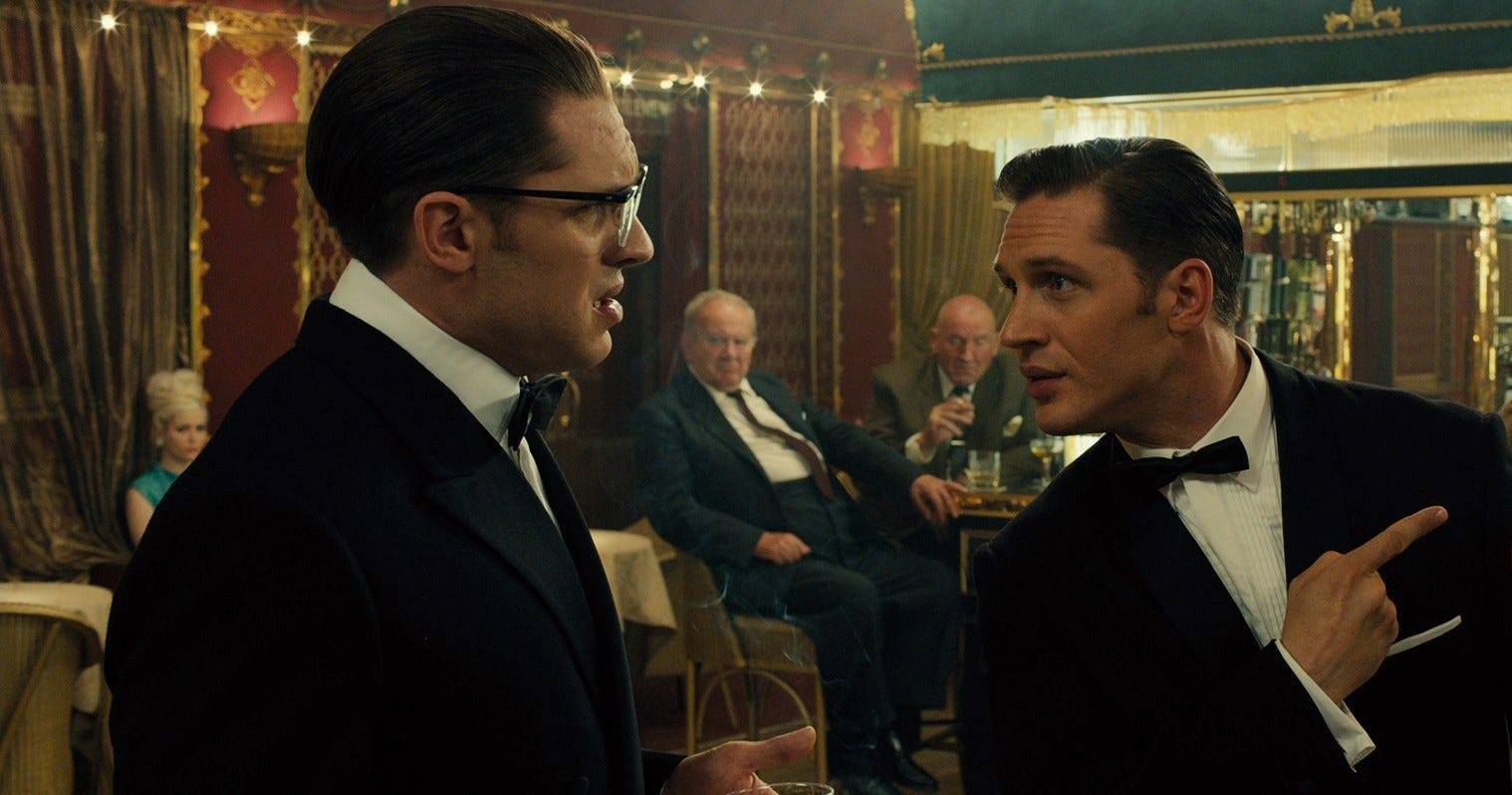
I happen to think that, if you show me a respected actor who only shows up in leading roles in small indies, I’ll show you a guy struggling, and failing, to sell out. For a while, Ryan Gosling and Jake Gyllenhaal were looked at as leading men with “integrity”, but both infamously auditioned for “Green Lantern”. Tom Hardy is no different in my eyes – after comparing his villain role in “The Dark Knight Rises” to “working at a Starbucks” in an interview, he walked across the street to punch the clock at McDonald’s, starring in a ludicrous trilogy of “Venom” films for Sony. I don’t judge it (ok, maybe a little), but it’s worth being honest about how little raw talent and a penchant for wacky accents don’t pay the bills.
Before he stepped in as “Venom” (during a period where he was also making weird cameos in the world of “Star Wars”, “The Matrix” and, conspicuously, “Spider-Man”), he had a remarkable 2015, appearing in five movies. Two of them, “Child 44” and “London Road”, were not well-received. One of them, “Mad Max: Fury Road”, might be one of the greatest cinematic experiences of the 21st century – I do wish I could have seen it on the big screen, and not bootlegged in a prison TV room. And then there was “The Revenant”, which earned Hardy his first and only Oscar nomination. But none of those movies represented the workload he took on in “Legend”.
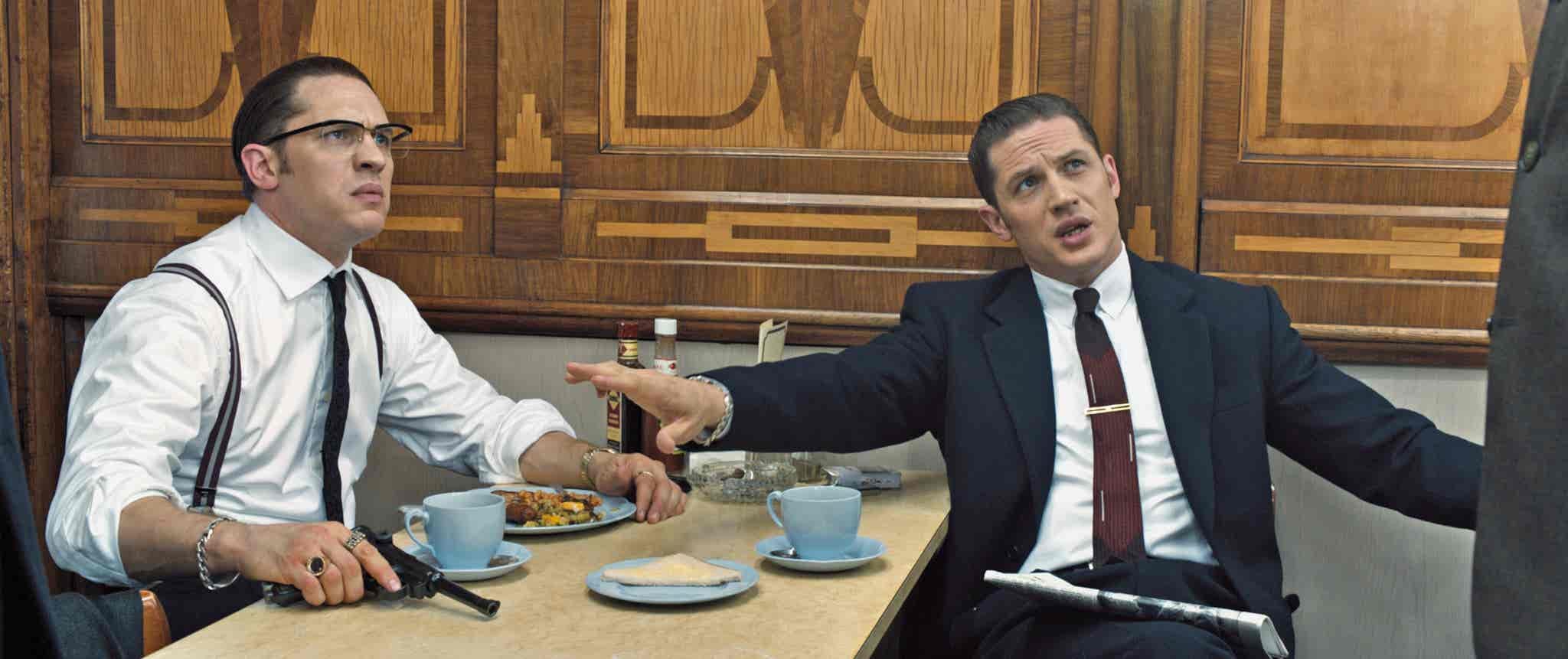
In “Legend”, Hardy stars, and co-stars, as Reginald and Ronald Kray, a couple of brothers and infamous British crime lords in the 1960’s. They’re both distinct types, giving Hardy a chance to really toy with different characterizations inside the same narrative. Both of these men are cruel and bloodthirsty, quick to challenge with violence. Reggie is the brother with the more thoughtful, methodical approach, mindful of his surroundings as he badgers and bludgeons underlings. Ronald, mentally disturbed and prone to fits of violence, is the less-predicable and more volatile of the two. Ronald is also openly gay, in a time and milieu that would be uncharitable toward his inclinations. It’s notable that he seems to use his homosexuality as a weapon, and his desires seem less about arousal and more about dominance.
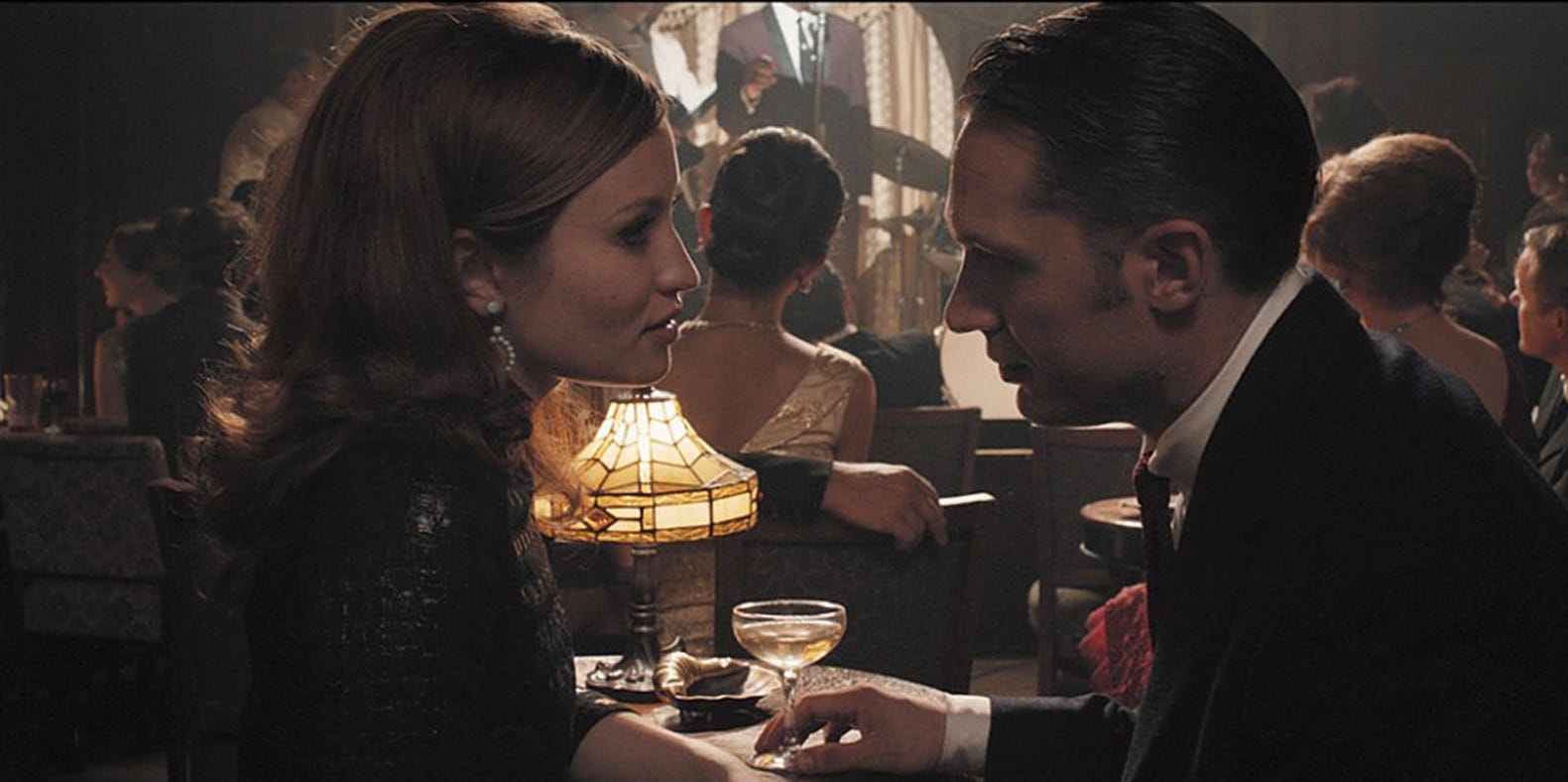
Reggie ends up in a semi-steady relationship to young Frances, who narrates the movie. She’s played by Emily Browning, and though she was the younger woman in real life, the film accentuates this by having the slight-of-frame Browning shrink in the presence of the much-older Hardy (who is maybe a decade-plus older than either of the Krays during the film’s runtime). Frances can never get through to Reggie, who has less chemistry with her than he does with his own twin. Reggie cares for Frances, but it seems as if he actually, deeply loves Ron, a short fuse eternally ready to go off. I suppose it’s a bit of narrative playfulness to note the homoerotic incestuous tension between a single actor and himself. Tom Hardy, eternally a weirdo.
Much of “Legend” consists of meetings with various crime figures who disagree with how the Krays do business. You’re just waiting for the burst of violence that’s going to end every interaction. Is it going to come from Reggie, who is going to slowly eye everyone opposing him, and consider whether or not someone needs a punch in the face? Or is it going to be Ronald, who will pull out a gun and attempt suicide by pointing it at eight other armed men? Director Brian Helgeland (writer of “L.A. Confidential”, director of “42”) doesn’t always make this cinematic, but he doesn’t need to do much work when you have two wily Tom Hardy performances sharing the screen. This is a familiar rise-and-fall story, only the rise is notably more brutal (and thus, darkly funny) than your usual true crime tale.
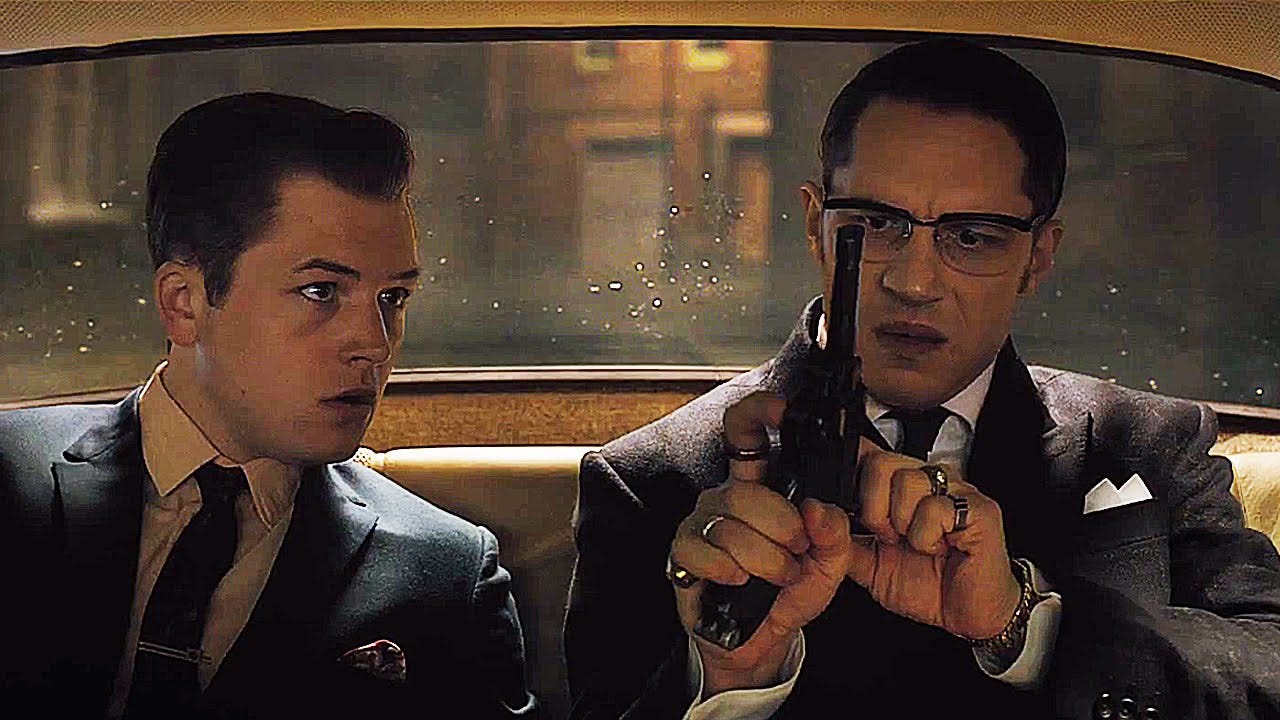
While Hardy is always dominating the frame, there’s plenty of time for a few fun faces to show up. Paul Bettany appears as a former boss usurped by the Krays’ local power, and David Thewlis brings his smarm to the part of a Krays’ associate. Taron Edgerton makes a surprising appearance as one of Ronald’s boyfriends, and goony character actor Sam Spruell (you know the face more than the name) is a sadistic underling who proves to be a liability. Most interestingly is Chazz Palmentari, who feels like he’s been playing mobsters since before any of us were born. He appears as a Philly mob boss named Angelo Bruno, a fast-talking glad-handler trying to develop a crossatlantic business relationship with the Krays. There’s a great moment where oversharing Ron describes his sexual tastes to Bruno in great detail, in the midst of a meeting where Reggie has already had the tightest of sphincters. The way Palminteri drags out the suspense before responding in a warmly receptive way is a reminder that Palmentari has been denied some of the good roles his peers have received over the years.
But this is primarily Hardy’s movie, and he misses no opportunity to chew any scenery still standing. From early on, the Krays control the narrative completely, they are aggressors and enforcers from the movie’s first moments, and little arises to challenge their throne. It’s true of the Krays as it is for the two Hardys, and the movie, to its credit, features a number of scenes where he gets to physically interact with himself in ways that test a common but still tricky special effect. You can tell these brothers care for each other, but they’ve also likely read the script. They know that they’re headed for a fiery ending, and they’re wondering who is going to be responsible, the too-trusting Reggie or the reckless Ronald. The tension between the two is enhanced, metafictionally, by both of them being played by the same guy. It’s a spirit, an attitude, an actor, at war with himself, and the collateral damage is considerable. “Legend” never rises up to become a Cockney classic, but isn’t it enough to see a great actor ram his head against himself right before he entered his sell-out phase?
This is an interesting news story that, again, reflects the changing priorities of the FBI. An arsonist protesting our current political situation in America was arrested for setting fire to a warehouse in California. The US attorney who prosecuted the case was quoted comparing this fire as an attack on “our values, our way of life, our system”, which is fascinating to me. No one was injured in the fire, so I’m personally wondering which of my values were attacked by a warehouse burning down across the country from me. It’s a revealing comment because of that last part – a “system” that was attacked, a system that did not involve the lifestyle of the arsonist (who worked for a third-party contractor), does not involve my lifestyle, and probably has nothing to do with yours. Of course, the system they’re talking about is capitalism. None of this is a secret.
I’ve written about this before, but it’s clear we’re seeing a massive shift in our federal law enforcement apparatus to focus on politics and free speech. Apparently, it is not only un-American to criticize a system that places an absurd and society-crushing amount of wealth in the hands of an upper 1%, it’s now criminal. Homeland Security has already labeled “class-based or economic grievances” as a mark of extremism that can be classified as a threat. And why not? The closest thing for the goons in charge to religion – the idea that they’re not responsible for their own cruel actions, which include the suffering of the less-fortunate – is capitalism. Capitalism, a magical system where money, run through banks and business, is actually distributed through destiny and birthright, through magic and mystery, based on forces far beyond the control of those who literally control and command all the wealth. In this America, the law doesn’t think you matter. In this America, only the system matters.
Agree with you on Mad Max Fury Road. For me, that was Charlize Theron's movie, forgot Tom was in it!
I don't think Legend gets near the eerie and violet The Krays (1990). I found Hardy's to be ok here but you make a good point about some of his acting choices.
A lot of people I've spoken with really liked his performance in Mobland but I felt/feel he's becoming a caricature of himself in some of these roles.