
Guava Island
And Abuse Of Augmentation


Welcome to another MUSIC WEEK here at From The Yard To The Arthouse! And today, we’re dealing with a petty weirdo anomaly. You might want to put me on-blast for this one, since there are a lot of issues here. For one, “Guava Island” is a little less than an hour, so technically it’s feature length, but you all might be looking for something with a bit more size to it. Oh, and another thing: technically this movie doesn’t even exist. It was made for Amazon, or in conjunction with Amazon, or inside a mysterious hive owned by Jeff Bezos, wherever Amazon content survives. And at some point, Amazon went and erased it. It’s not there anymore. I’m sure you can go clicking around and find it, but, uh, be careful with viruses, and whatever else Bezos keeps in those hives. Dementors?
This is a notable pairing of two superstars, Donald Glover and Rihanna. I told a lovely acquaintance about this film, and her first excited question was, “How do they look together?” I’m glad to report that these two look phenomenal together, and it feels, appropriately, like two superstars sharing the screen. The two play Deni and Kofi, who live on Guava Island, which seems as if it’s in the vicinity of Cuba. Kofi, who narrates, is the 9-to-5-er of the two, working in a small textiles factory alongside Yara (Black Panther herself Letitia Wright) and wondering if she can ever escape this mundane life. She dreams of a family with Deni – he too is a dreamer, though she feels as if he dreams of everything but that.
Deni is a musician, not unlike the fabled Bando Stone (from a movie that also genuinely may not exist at all). He’s not afraid to start playing instruments or dropping a rhyme. When it comes to music, he’s about that life. Early on, you find out he’s scheduled a concert for everyone to attend, to the point where he tries to bribe and entice local criminals to cease operations for a day. Not dissimilarly, he’s earned the ire of Red (Nonso Anozie), who runs most of the businesses on the island and who stands to lose a lot of productivity hours if his employees decide to enjoy Deni’s concert. Red pushes Deni to reconsider, but not in a friendly way.
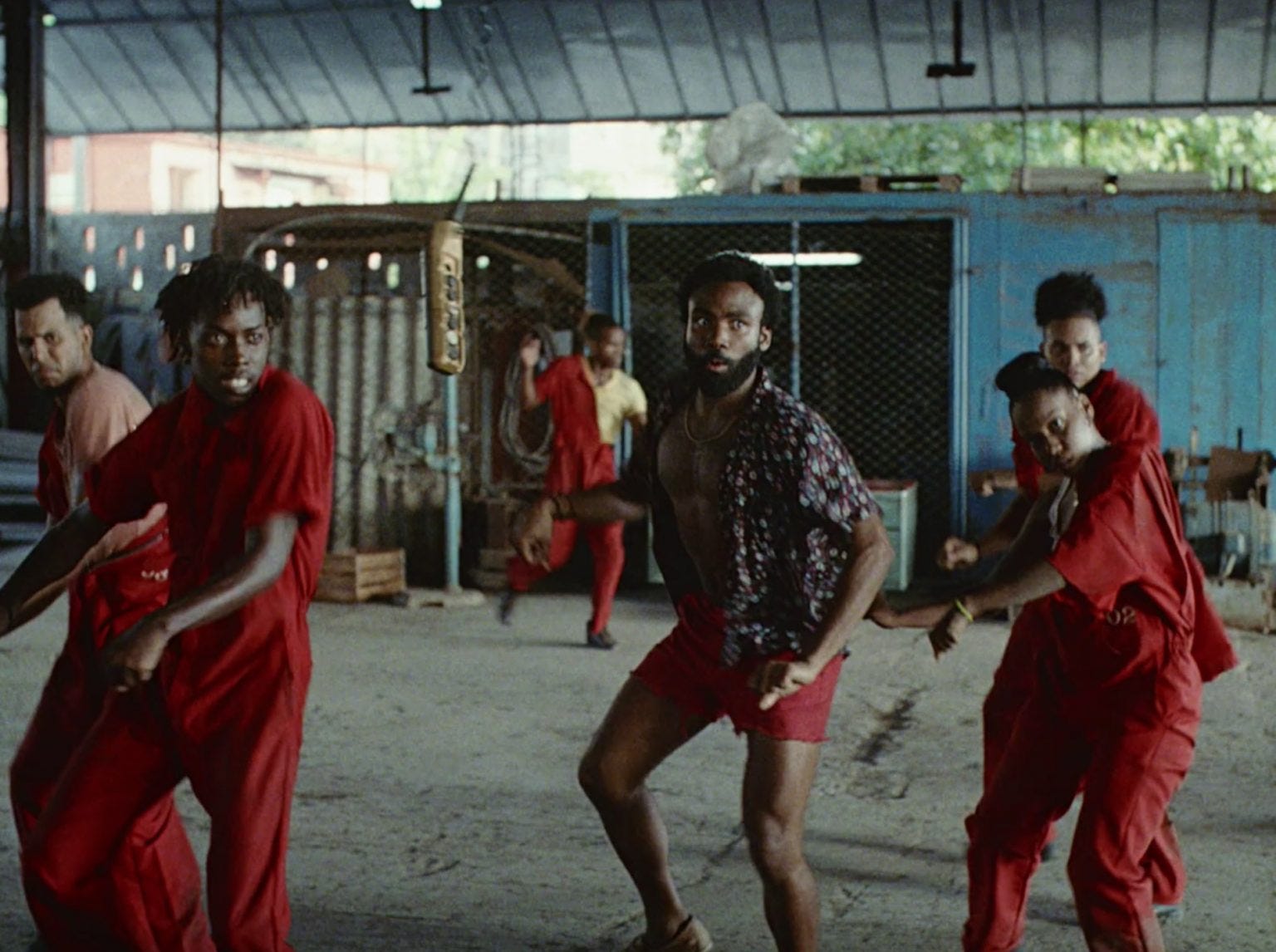
Deni is unmoved, because this is Glover at his most irrepressible. He dreams of making it to America, if only for the chance to hustle as he already does, but on a large scale. It’s almost as if this is a “normal” movie that Deni wills into a musical. Sometimes the music is diegetic, sometimes not. Often, he’ll start serenading Kofi, whom he genuinely loves (which is not really acting, because Rihanna). But at one point, he launches into a fully-choreographed, remixed version of Childish Gambino’s “This Is America”, the song I was told was huge when I was in prison though I never once heard it on the radio – IHeartRadio’s stations, as afraid of Black people as they were in 1992. They wouldn’t play it, but they sure loved force-feeding me G-Easy. By the way, I know most people are streaming music, but did you know IHeartRadio, as of a couple of years ago, was still doing that thing where they have a track with a white singer and a Black rapper and they’d edit out the rap?
“Guava Island” has the feel of a refreshing icee in a cone on a hot day, dripping, cool, and designed to evaporate quickly. This is largely the work of the core creative team behind “Atlanta”, FX’s breathtaking boundary-pushing series, with Donald’s brother Stephen writing the screenplay and the show’s primary director Hiro Murai behind the camera. The movie feels like summer, all breezy open shirts and sun-kissed waves, everyone wrapped in their own smiles. Once you arrive at the end, you recognize how bittersweet this was meant to be, how ephemeral, an obvious, doomed plot building to its only natural conclusion. Along the way, there are beautiful people, there is song and dance, there is a sense of finality to it. It fits with Glover’s Childish Gambino persona, which felt like a skin-shedding act the entire time. This was just another Donald Glover chapter. More followed.

When I was in prison, I witnessed “augmentation”, but I didn’t yet know what it was called. It’s a unique, and frankly abusive, loophole in the hiring of staff. Imagine if you were weighing the pros and cons of working in a prison as a nurse, being around dangerous people, and being placed in dangerous situations. Now imagine you were being compensated not only for nursing, but to be an occasional commanding officer, a c.o. who could monitor and discipline inmates. All prison employees are trained to operate as a c.o. in case of some sort of emergency. It appears that the definition of “emergency” is being stretched, requiring augmentation to occur more often, according to this article. Which makes me remember the time nurses from the medical ward would be running our unit, not only working a shift as a c.o. but doing so knowing that understaffing meant their backup was slim, if it existed at all. And as the article mentions, this is on the back of several institutions being short on medical professionals in the first place.
Understaffing is a serious issue, but for prisons, it’s an issue of bodies and numbers. They only need to re-arrange staff members like chess pieces in order to be in compliance with the law. It doesn’t seem to matter that inmates aren’t getting the proper help. It benefits the Bureau of Prisons to employ staff members who serve several functions in order to spread workers thin and keep a tight budget. Augmentation is essentially based on the honor code, the idea that you won’t need to keep pulling from other areas of the institution to fulfill staffing quotas before you have enough staff, and you have no reason to be short of staff because everyone is compensated fairly. Why assume the honor code in a system where the “honor” is built upon putting men in cages?