
Colossal
And The Futility Of Restitution


This has been a week of doubles, doppelgangers and clones, but we haven’t had proper monster representation. Many doubling-type stories build upon the Jekyll-Hyde framework, where a character isn’t aware that they are two wholly distinct personalities. Unrelatedly, there have been dozens of kaiju movies made over the decades. So what if someone attempted a Jekyll-Hyde tale, but with kaiju? That’s the tonal gamble that director Nacho Vigalando makes with “Colossal”.
Technically, “Colossal”’s most important story is that there is a giant monster attempting to destroy Korea. But the movie, by and large, is about real people on the ground who have other, more specific interpersonal problems. I’ve always wanted to see more of that. Just because asteroids are hitting the Earth or creatures have climbed out from the Earth’s core doesn’t mean that someone isn’t having girlfriend problems, or a mother can’t afford to feed her family, or a kid needs her driver’s license validated. I’d love to see a “Jurassic World” movie that brings back Alan Grant, trying to sell his archeological finds so he can buy a boat in a world where velociraptors are breaking loose in downtown Manhattan. There’s a bit in “Moonfall” where the moon is falling – I won’t say when, that’s a spoiler – and, when recruited on a mission into space, Patrick Wilson turns it down and says, “I got a lot of my own problems down here.” Those must be some pretty big problems, guy! I wanna see THAT movie.
Instead, we’re in New Hampshire, where Anne Hathaway’s Gloria is crashing out. Her boyfriend in New York not only dumped her, but fully kicked her out, leaving her with no recourse other than to go home with nothing in her pocket. An underemployed writer, her only option is to go see childhood friend Oscar (Jason Sudeikis), who runs a bar and is happy to employ her as a bartender. Which is a terrible idea, because Gloria is an alcoholic, and she cannot hold her beer like Oscar, basic Joel (Austin Stowell) and conspiracy theorist Garth (Tim Blake Nelson), who all shut down the bar every night with several rounds of drinks. Oscar wants to help Gloria, and he also has fairly fond feelings towards her, but he is quite obviously indulging bad behavior.

In what I assume is simply movie magic, Gloria discovers that she might have a relationship to these monster attacks halfway across the world. She wakes up long after they’ve occurred, though she soon realizes the monster is acting out her blackout-drunk behavior during a certain time of the night when she’s absolutely blitzed. Personally, I would think the booze is doing this, but apparently it’s the playground across the street where she’s able to create the beast, which then causes such a manifestation appearing elsewhere. Gloria is amused that she has this sudden ability to control a scaly beast laying waste to Seoul, until she grasps the severity of that devastation. Hundreds are dying under the monster’s foot, all because Gloria can’t control her consumption issues.
What’s novel is that the New York boyfriend, Tim (Dan Stevens) returns, seeking Gloria’s help. And then this becomes something of a romantic comedy, though within the framework of a kaiju movie. Tim, British, persnickety and well-off, is technically an upgrade over slovenly Oscar. Of course, he’s a stiff, and Oscar’s the life of the party – it’s irrelevant, but this is not a great use of Dan Stevens. And as she decides between her two suitors, her beastly avatar is finding select moments to lay waste to urban Korean environments, just as Tim and Oscar are squaring off like Godzilla and Ghidorah.
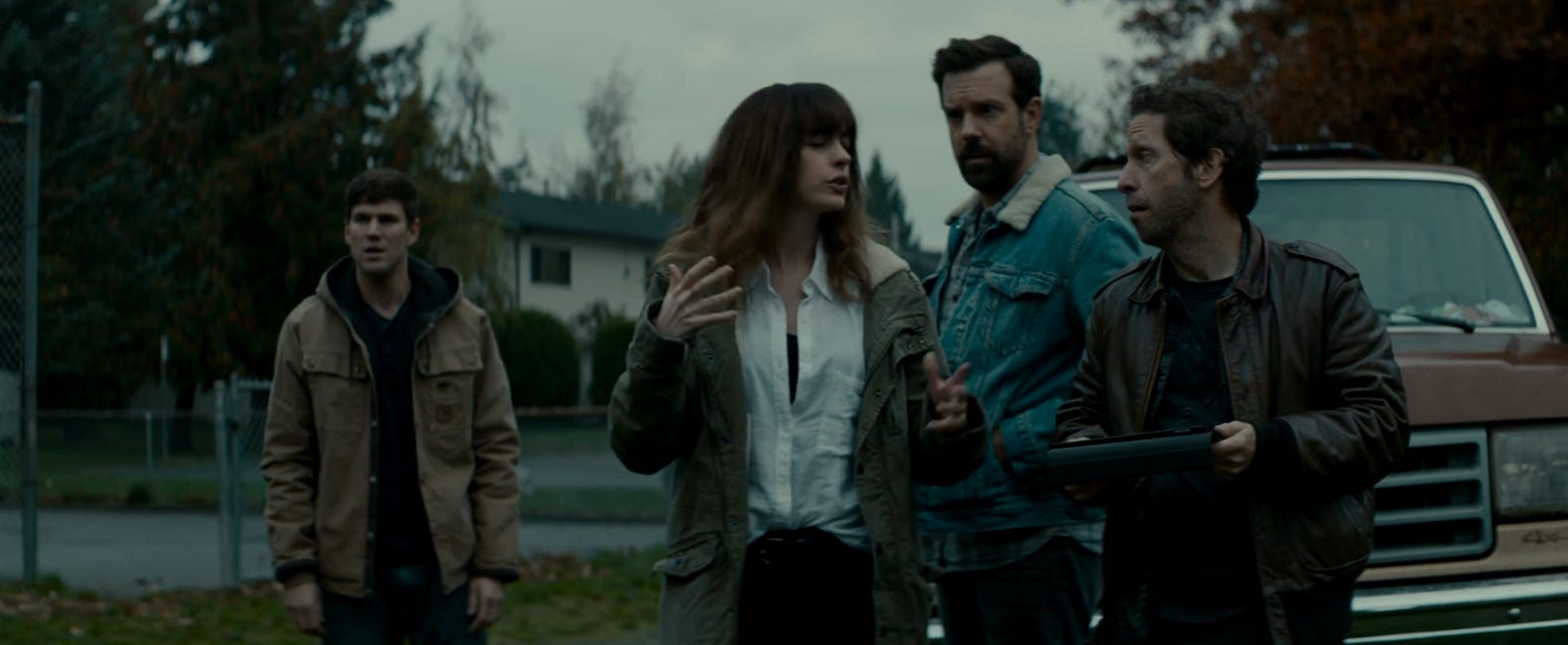
It’s a wild genre hybrid, and because of these authentic performances, it works. It’s atypical to see an Oscar winner as a screw-up drunk in a monster movie, but Hathaway is tremendously game to play a mess while grounding her fear of her monster shadow in a recognizable reality. Sudeikis has that young Chevy Chase charm – not that he’s secretly a jerk and will be outed in a few decades, but that he’s charming despite little-to-no effort. You kind of wish Tim was more drawn in – these romantic triangles usually have one under-defined angle, and from some perspectives Tim seems like a guy destined to be left behind. But as we learn about Oscar, we realize he’s not necessarily a catch either, and Gloria ends up wrestling with his role in her past. “Colossal” has many easy storytelling off-ramps it can take, and to it’s credit, it ignores most of them.
Vigalando is a truly slept-on genre filmmaker, a man who matches low-budget big-stakes genre filmmaking with intimate character interactions. “Colossal” reminds me closely of his second film, “Extraterrestrial”. That picture, a Spanish thriller, is about a man who wakes up after a one night stand in an unfamiliar home only to realize an alien invasion is going on, trapping him inside with his lover from the previous night and the accompanying hazy memories. It is a great example of the dramatic genre picture boiled down to interpersonal dynamics, as much about the couple’s survival as it is about the impending apocalypse. Few filmmakers are capable of this unique balance, which is disappointing considering that Vigalando is a guy that should be working more, on a larger budget. But “Colossal”, his first and last time with above-the-title American stars, is proof that our big action spectacles no longer have to be about the same people in the same repetitive situations.

Restitution is a concept that many hear about in the world of criminal justice. As a condition of your charge, you may be asked to provide restitution as repentance for your crime, either towards the victim or towards the government. But collecting the restitution proves to be a challenge for many municipalities. This article focuses on the struggles in Oregon, where the collection rate for restitution has hovered just under 40% for years now. Not only is that a lot of money not accounted for, but it’s money that’s sought with a receipt – it gets expensive to pursue the convicted in search of money, money that might not even plausibly exist. In Oregon alone, this shortfall in restitution, and the accompanying failed attempts, has cost the state $1.4 billion.
Much of this money is sought from people who could never afford it in the first place, the suffering of victims boiled down to a number that the perpetrator cannot provide. So it becomes a challenge to chase the paychecks of the poor to fulfill these needs. White collar crimes frequently carry restitution penalties as well, but the people accused are typically men and women skilled at hiding their earnings and wealth. Beyond that, I don’t have a particularly clear idea how someone is further rehabilitated, and the public trust is upheld, by forcing those convicted of crimes to cut a check. It’s yet another rickety part of our justice system that has endured for decades despite a faulty mechanism and dubious gain for our society. When states see situations like a missing $1.4 billion in Oregon, it’s likely they begin considering practical solutions to this problem.
On Monday, you’d better freshen up. It’s FASHION WEEK.
This was great. I love how Colossal uses the kaiju setup to tell something so much messier and more intimate than you expect, and Hathaway really holds the whole thing together. I also liked your point that the movie keeps shrinking the giant-monster premise back down to damaged people and bad choices. Thanks for putting this back on my radar. I need to revisit it.