
Appropriate Behavior
And How No One Tells You Where You're Going


I first saw Desiree Akhavan in “Creep 2” (yes, review forthcoming). She was the “final girl”, I suppose, if you can consider that she’s half of the primarily two-person cast. I was immediately taken with her, her obvious onscreen intelligence, her intriguing, angular physical appearance (she is of Persian descent) and her willingness to do what another pervy male mumblecore filmmaker was going to guilt her into doing. She emerged from that no-budget exploitation feature with enough dignity that I immediately looked her up. I was not-at-all-surprised to find out she was actually a fairly accomplished filmmaker. “Appopriate Behavior”, a personal-seeming low-budget story, was her first feature length offering, and already, Akhavan was establishing herself as someone with a voice but not an obtrusive or unpleasant way of expressing it. This is not the bleak sort of indie filmmaking you get from marginalized voices with justifiable doomsday stances. But it’s also not the carefree sitcommy storytelling you see in these types of movies where everyone has a lukewarm quip right out of the microwave.
Akhavan is the sole writer, director and star of “Appropriate Behavior”, and it is a tale about a young woman who hasn’t reasonably learned how to properly “adult”. When we meet Akhavan’s Shirin, she’s moving out of her apartment she shared with a girlfriend, and it sounds like the relationship did not end well. While this is the movie’s loose present tense, there are a series of flashbacks that show you the trajectory of their affair. A familiar device, but a choice is made to showcase this specific duo in this specific way. These seem like two real people, having authentic interactions. But they also have a contradictory water-and-oil chemistry.
I want to focus on this, because I’m writing about films detailing the lifestyles of the LGBTQ community. So in a case like this, I can only observe from a distance, comparing this back-and-forth between the two of them to heterosexual relationships. Akhavan’s the bisexual member of the duo, and as such she seems to present as a conventionally-cisgender attractive woman, at least to my dumb straight eyes. But Rebecca Henderson’s Maxine is more buttoned-up, with a more traditional genderfluid appearance, short hair, a monotone voice, tight and composed body language. She is a lesbian unattracted to men. When they first meet, it’s immediately such an obvious scenario where opposites clash, a conflict they lean into to fuel their ongoing affections for each other. Which seems like such an aggressively bad idea, though because of the broken chronology, you already know that. I winced when the two of them came together at a party, and a drunken Shirin immediately made a handful of off-color jokes that Maxine humorlessly batted away. Sometimes, lust and chemistry are at odds. My curiosity laid in whether or not an outspoken bisexual and a professional lesbian can really work together in a relationship. Guys, I don’t have a lotta gay friends, sorry. I’d like some!

Shirin doesn’t have many resources or options, and so despite being an aspiring filmmaker, she takes a job teaching film to youth. Of course, she must have been unfamiliar with the fine print, because the kids are kindergarten age, and completely incapable of understanding anything about movies. Most of the time is spent in class with her struggling to get their attention while they play with blocks. Making a movie is the furthest thing from their mind. It is somewhat amusing when early on, a parent leaves her child in the class as if she’s chucked them away, because any program will do when it comes to getting some quiet time. At that point, you imagine Shirin isn’t feeling too well about herself.
While she still makes an effort to maintain a social life (with a bestie played by former indie queen Halley Feiffer) her main issue is the fear that her wealthy conservative family will find out she is bisexual. She hasn’t told them yet, though the suspicion is that these are the types of people who simply don’t believe in bisexuality. Maxine just seemed like a friend to their daughter. This isn’t a movie looking to gin up fake drama, so she does come out to her accepting brother. It’s that obnoxious dude Arian Moayed from “Succession” and a few Marvel projects (he’s the Damage Control guy, MCU’ers), but in small does he’s likable and charming in this, and more importantly, sweetly dismissive of the idea that Shirin’s sexual identity is a big deal.

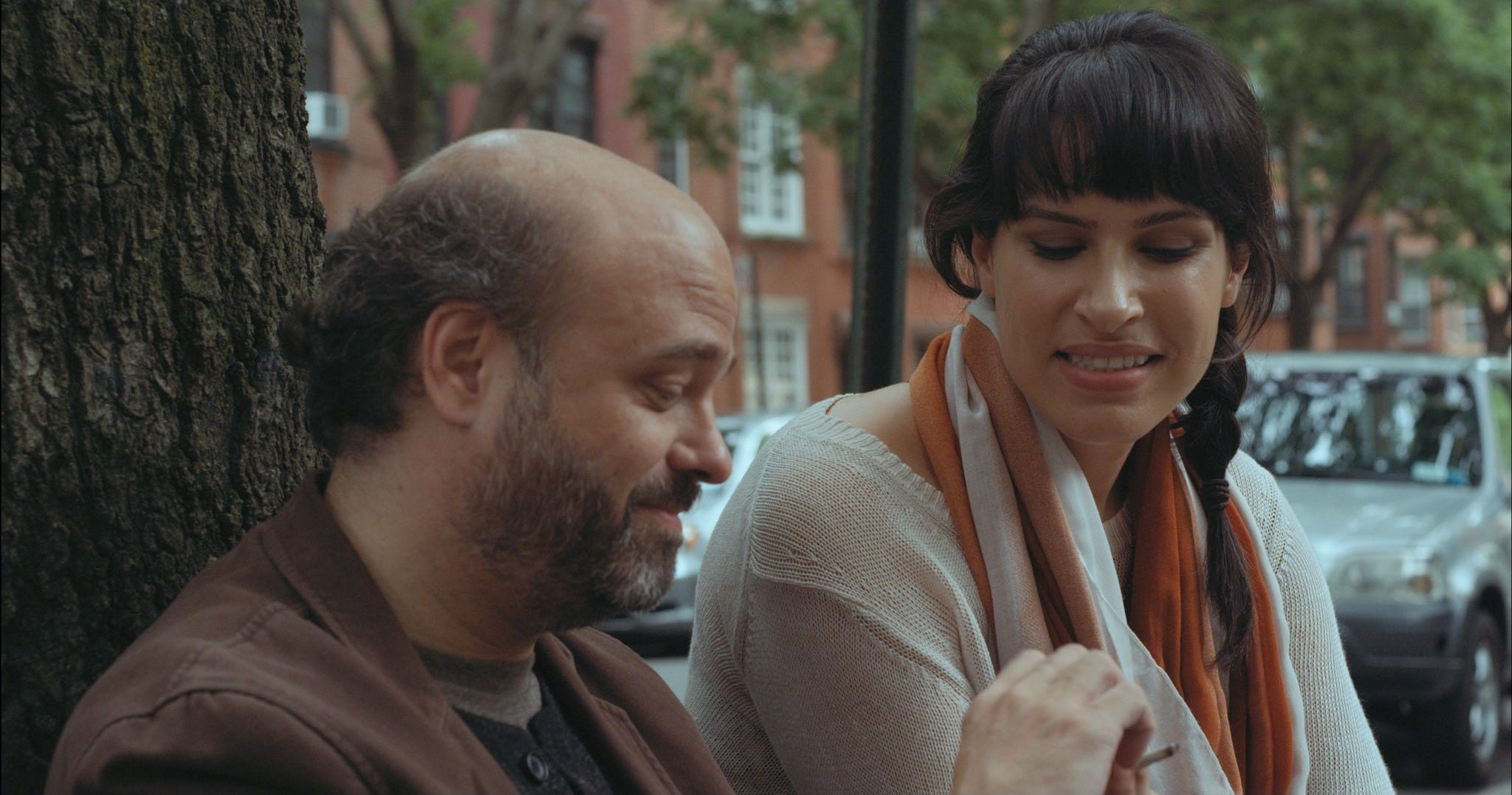
Shirin’s chief response to this entire scenario is devastation. She holds out hope that Maxine might change her mind. But because she’s still in her twenties, she’s willing to try to redefine her sexuality, at one point following a couple home, at another dating a man with a performatively-ridiculous mustache, and maybe even flirting with the balding parent of one of her students (Scott Adsit of “30 Rock”). The film does drag in trying to find a new spin on these topics – some of her reactions to these developments are funny, mostly due to Akhavan’s deadpan incredulity, but a lot of it is realistically mundane in a way that simply isn’t cinematic. The movie’s an even ninety minutes, but it’s not a sprint. Frankly, because I have limited and narrow interests, I would have liked more New York atmosphere, as there’s not much visual variance from one home or apartment to the other as far as the film’s minimal locations.
But that’s probably because what we’re dealing with is identity. Part of Shirin’s takeaway from the dissolution of her relationship with Maxine is that she just might not be the carefree bisexual woman she thought she was. It’s a wide prism, and as Shirin starts to question her place in it, in the wake of an unsuccessful relationship, it becomes more of an insular journey. If I didn’t know what a straight man was supposed to be, I’d have many resources to guide me, frankly too many. What seems true with Akahvan is that there aren’t nearly as many resources to inform you as to whether or not you’re “doing bisexuality” well enough. Which is, likely, why this movie exists in the first place.
Every once in a while, I read about recent practices by ICE, and I recognize them as behaviors and practices endorsed by the Bureau of Prisons. I’ve written before about the idea of prisoners being human furniture, but according to many sources, prisoners in ICE have been used more like footballs, being punted from one region to another, often without warning. The aim is, transparently, to frustrate detainees who are trying to interact with legal counsel, stay close to families, and generally survive. There’s a telling admission in that link from an ICE official who claims detainees have “access” to phones. These centers operate with phone accounts paid for through commissary money. Commissary money has to be sent from outside, placed into a detainee’s account, a process that takes several days. Phone numbers need to be requested by the detainee and then approved by the institution – a hard ask today when no one remembers anyone’s number due to the ease of smartphones. Oh, and it’s likely you can’t put money on someone’s account unless you know where they are. And if you have money in one commissary account, it’s supposed to transfer to the next institution. Didn’t happen to me or anyone I knew.
Your questions are valid, but I don’t have an adequate-enough explanation as to how they can, on a whim, send you to another institution with no justification. For federal inmates, there is a database to find an inmate, but it takes time to update. When I was sentenced, I was moved from my holding center, a jail in Newark. They can’t tell you when, and they can’t tell you where you’re going, because conceivably, you can share that information, and someone can help pull you out of custody. I was scheduled to go to a specific federal facility. No one told me that I would be taken to another holding facility for an additional three weeks. Before I was able to let my family know where I was – a period complicated by being stretched over a Thanksgiving holiday where the feds seemingly shut down – I was whisked away to said federal institution. The next time I would make that trip, I would first have to go to another holding facility, before ending up in a penitentiary of all places, and then arriving at my next federal prison. Nobody was bothered that I had no idea where I was going, who would know, or if the feds were covertly trying to get rid of me. But that’s a story for another time.
Were the off-colour jokes to do with Maxine's queerness? I've known bisexuals who responded to pressure to prove their queerness by coming onto high-signaling lesbians in a pressing and so ultimately off-colour manner. As for Maxine, her response echoes a scarcity mindset in the sense that a dating pool for lesbians and gay men is simply way smaller than one for straight people (or queer people of more fluid sexuality); take what you can get etc.. Sounds like a roided off-shoot of a trauma bond, in any case.
(third!)
First!
💯